



How Many Axes Do I Need? Choosing the Right CNC Spring Machine
How Many Axes Do I Need? Choosing the Right CNC Spring Machine
Selecting the right CNC spring machine is one of the most important decisions for spring manufacturers. One of the most common questions buyers ask is:
"How many axes do I need?"
The answer depends on the complexity of the spring, wire diameter, production volume, and future product requirements. While some manufacturers only need an 8-axis machine for standard compression springs, others may require 12-axis or even more advanced multi-axis systems to produce complex wire forms and precision springs.
This guide explains how CNC spring machine axes work and how to determine the best configuration for your business.
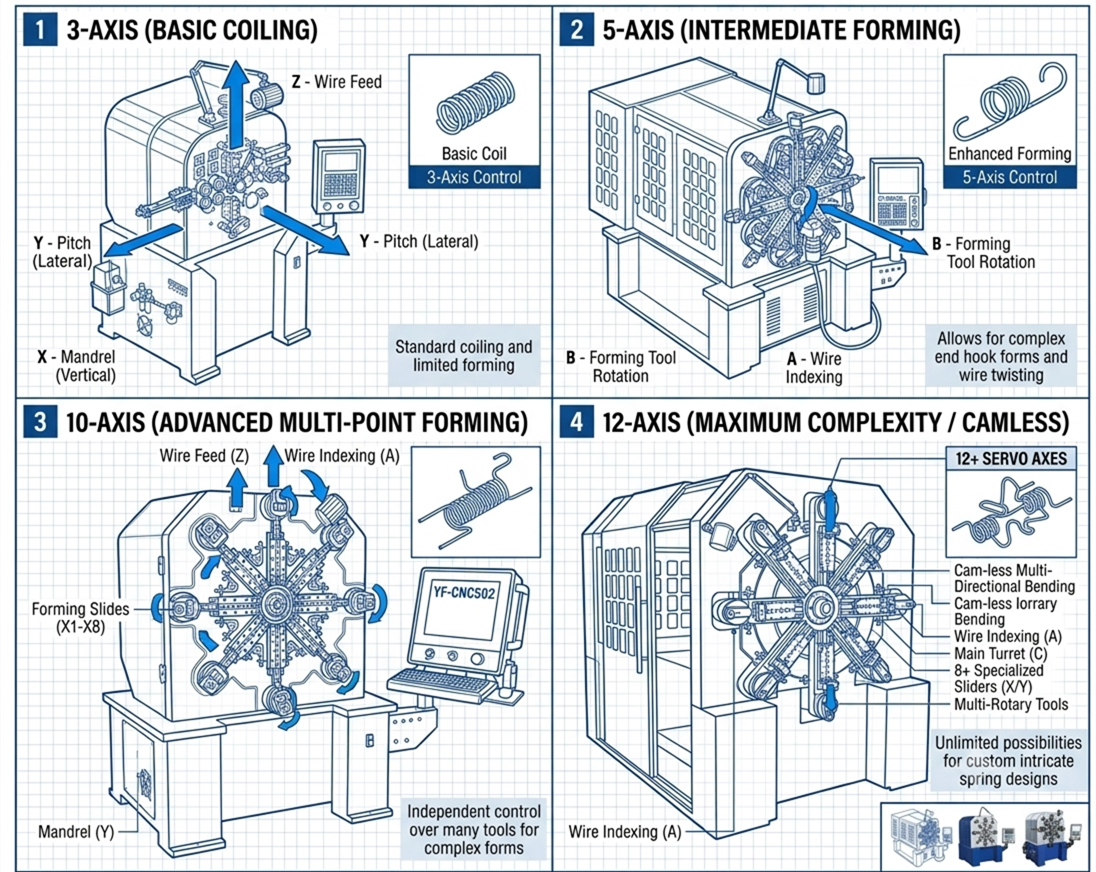
What Does "Axis" Mean in a CNC Spring Machine?
In a CNC spring machine, an axis refers to an independently controlled servo-driven movement. Each axis controls a specific forming function such as:
Wire feeding
Coiling
Pitch control
Cutter movement
Forming tools
Rotating quills
Wire bending actions
The more axes available, the more complex spring geometries and wire forms the machine can produce.
When Is an 8-Axis Spring Machine Enough?
An 8-axis CNC spring machine is ideal for:
Compression springs
Simple extension springs
Standard torsion springs
General industrial springs
Advantages:
Lower investment cost
Easier programming
Faster setup for standard products
Suitable for high-volume production
Recommended for manufacturers producing relatively simple spring designs with limited shape complexity.
When Should You Choose a 12-Axis Spring Machine?
A 12-axis machine provides significantly greater flexibility.
Suitable applications include:
Complex torsion springs
Double torsion springs
Automotive springs
Precision industrial springs
Special-shaped springs
Benefits:
More forming tools can work simultaneously
Greater design flexibility
Reduced secondary operations
Better accuracy for complex products
For many growing spring manufacturers, a 12-axis machine offers the best balance between capability and investment.
When Do You Need Multi-Axis Camless Technology?
Modern camless spring machines use independently controlled servo axes instead of traditional cam mechanisms.
These machines are recommended when producing:
Complex wire forms
Automotive components
Medical springs
Precision electronic springs
Custom-shaped products
Advantages include:
Faster product changeovers
Easier programming
Higher flexibility
Reduced tooling requirements
Improved production efficiency
Camless technology is becoming the preferred solution for manufacturers handling multiple product types and small-batch production.
How Wire Diameter Influences Machine Selection
Wire diameter is another critical factor.
Typical recommendations:
| Wire Diameter | Recommended Machine Type |
|---|---|
| 0.2mm - 3.0mm | Small CNC Spring Machine |
| 3.0mm - 8.0mm | Multi-Axis Spring Machine |
| 8.0mm - 16.0mm | Heavy-Duty Spring Machine |
| 16mm+ | Large Spring Production Equipment |
Manufacturers producing heavy-duty suspension springs, railway springs, or mining equipment springs often require large spring machines with enhanced forming capability.
Consider Future Product Expansion
Many manufacturers purchase equipment based only on current production needs.
However, future requirements should also be considered.
Questions to ask:
Will product complexity increase?
Will new industries be served?
Will wire diameters expand?
Will custom products become more common?
Choosing a machine with additional axis capability can reduce future equipment upgrades and increase long-term flexibility.
Which CNC Spring Machine Is Right for You?
The ideal machine depends on your products:
Standard compression springs → 8-axis machine
Automotive and industrial springs → 12-axis machine
Complex wire forms and custom shapes → Camless multi-axis machine
Heavy-duty springs up to 16mm wire → Large spring machine
By matching machine capability with product requirements, manufacturers can improve productivity, reduce setup time, and maximize return on investment.
Conclusion
There is no single answer to how many axes a CNC spring machine should have. The best choice depends on product complexity, wire diameter, production volume, and future growth plans.
Understanding the relationship between axis configuration and manufacturing capability allows spring producers to select equipment that delivers both current performance and long-term competitiveness.