
What Springs Are Best Produced on a Camless Spring Machine?
What Springs Are Best Produced on a Camless Spring Machine?
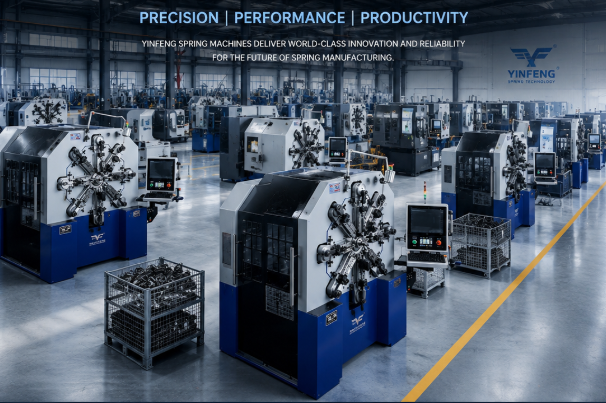
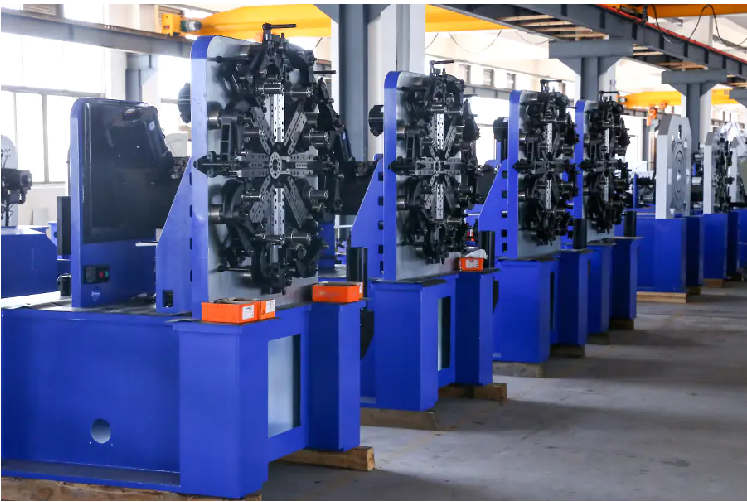
Camless spring machines have become increasingly popular in modern spring manufacturing due to their flexibility, precision, and ability to produce complex spring geometries. Unlike traditional cam-driven machines, camless spring machines use independent servo-controlled slides that allow faster setup, greater programming flexibility, and more precise motion control.
But what types of springs are best suited for a camless spring machine?
The answer depends on the complexity of the spring design and the level of production flexibility required.
What Is a Camless Spring Machine?
A camless spring machine replaces traditional mechanical cams with multiple servo-driven axes.
Instead of relying on fixed cam movements, each forming tool can move independently according to the CNC program.
This provides several advantages:
Faster setup and changeover
Greater design flexibility
Higher precision
Reduced mechanical wear
Easier programming for complex products
Because of these capabilities, camless technology is particularly valuable for manufacturing customized and complex spring products.
Why Choose a Camless Spring Machine?
Traditional cam machines perform well for long runs of simple springs. However, camless machines excel when manufacturers need:
Frequent product changes
Complex spring geometries
High precision requirements
Small and medium production batches
Custom spring development
The flexibility of independent servo control significantly expands production possibilities.
Compression Springs
Compression springs are among the most common products produced on camless spring machines.
Typical applications include:
Automotive components
Industrial equipment
Medical devices
Home appliances
Electronic products
Camless machines can efficiently produce:
Constant pitch compression springs
Variable pitch compression springs
Conical compression springs
Barrel springs
Hourglass springs
Products with non-standard geometries particularly benefit from camless technology.
Torsion Springs
Torsion springs are one of the best applications for camless spring machines.
These springs often require:
Precise leg positioning
Multiple bends
Complex end configurations
Tight dimensional tolerances
Independent servo slides enable accurate control of spring legs and forming angles.
Common applications include:
Door mechanisms
Automotive systems
Furniture hardware
Electrical switches
Extension Springs
Camless spring machines can also manufacture extension springs with high accuracy.
Features include:
Various hook styles
Consistent spring body dimensions
Complex end configurations
Typical products include:
Garage door springs
Industrial tension springs
Agricultural equipment springs
Mechanical return springs
Servo-controlled tooling simplifies the production of custom hook designs.
Double Torsion Springs
Double torsion springs often require multiple forming operations and precise symmetry.
Camless spring machines provide excellent control over:
Center spacing
Arm geometry
Coil consistency
Angular positioning
This makes them ideal for producing high-quality double torsion springs used in automotive, aerospace, and industrial applications.
Special-Shaped Springs
One of the greatest advantages of camless machines is their ability to manufacture special-shaped springs.
Examples include:
Formed wire springs
Irregular spring designs
Multi-bend spring products
Customized spring components
Products that would be difficult or time-consuming to produce on traditional cam machines can often be programmed and manufactured more efficiently using camless technology.
Wire Forms and Hybrid Products
Modern camless spring machines are often capable of producing both springs and wire forms.
Common products include:
Spring clips
Retainers
Wire brackets
Locking components
Custom wire assemblies
This versatility allows manufacturers to expand their product offerings without additional equipment investment.
Which Industries Benefit Most?
Automotive Industry
Produces precision springs, retainers, clips, and safety components.
Medical Industry
Manufactures high-precision spring products and specialized wire components.
Electronics Industry
Produces miniature springs and conductive wire forms.
Aerospace Industry
Requires complex spring geometries and strict dimensional control.
Industrial Equipment
Uses custom springs and formed wire components in machinery and automation systems.
When Is a Traditional Cam Machine Still Suitable?
Traditional cam spring machines may remain a good choice when:
Producing very high volumes of the same spring.
Product designs rarely change.
Spring geometry is relatively simple.
Lowest initial investment is the priority.
However, for manufacturers seeking flexibility and rapid product development, camless machines often provide greater long-term value.
Why Choose Yinfeng Camless Spring Machines?
Yinfeng camless spring machines offer:
Multi-axis servo control
High-speed production capability
Precise forming accuracy
Quick program changeover
Program storage and reuse
English and customized language support
Technical training and after-sales service
These features help manufacturers produce a wide range of springs efficiently and consistently.
Conclusion
Camless spring machines are best suited for complex, high-precision, and frequently changing spring products. Compression springs, torsion springs, extension springs, double torsion springs, special-shaped springs, and wire forms all benefit from the flexibility of servo-controlled camless technology.
For manufacturers seeking versatility, precision, and faster product development, camless spring machines represent one of the most advanced solutions in modern spring manufacturing.