Common Wire Forming Machine Problems and Solutions
Common Wire Forming Machine Problems and Solutions
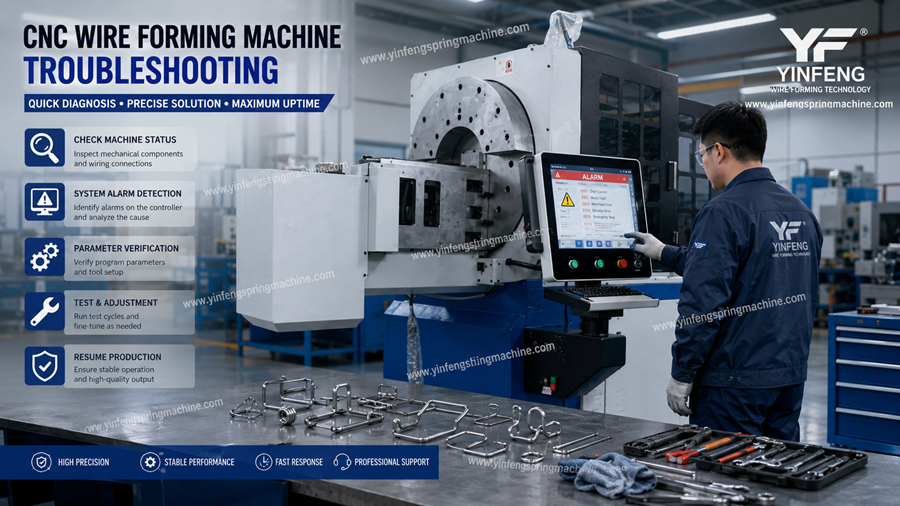
Wire forming machines are widely used to manufacture hooks, clips, brackets, frames, and custom wire products. Although modern CNC wire forming machines provide excellent precision and efficiency, production problems may occasionally occur.
Understanding common issues and their solutions can help manufacturers minimize downtime, improve product quality, and increase overall productivity.
1. Wire Feeding Problems
Symptoms
Unstable wire feeding
Inconsistent part dimensions
Wire slipping during production
Possible Causes
Worn feeding rollers
Improper wire tension
Dirty feeding mechanism
Poor wire quality
Solutions
Inspect and replace worn rollers.
Adjust wire tension settings.
Clean the feeding system regularly.
Use high-quality wire materials.
Stable wire feeding is essential for maintaining dimensional consistency.
2. Dimensional Accuracy Problems
Symptoms
Product size deviations
Inconsistent angles
Shape variations between batches
Possible Causes
Incorrect program settings
Tool wear
Servo calibration errors
Solutions
Verify machine parameters.
Replace worn tools.
Perform regular calibration.
Conduct first-piece inspection before mass production.
Regular inspection helps maintain consistent product quality.
3. Tool Wear and Damage
Symptoms
Surface scratches on products
Poor bending quality
Increased dimensional variation
Possible Causes
Processing hard materials
Excessive production speed
Improper tool alignment
Solutions
Replace worn tools promptly.
Optimize production speed.
Check tool positioning regularly.
Follow preventive maintenance schedules.
Proper tooling maintenance extends machine life and improves product quality.
4. Servo Motor Alarms
Symptoms
Machine stops unexpectedly
Alarm messages on the controller
Positioning errors
Possible Causes
Electrical connection issues
Overloaded servo motors
Encoder faults
Solutions
Inspect cables and connectors.
Reduce excessive load.
Check servo system parameters.
Contact technical support if necessary.
Early diagnosis can prevent more serious equipment failures.
5. Product Deformation
Symptoms
Incorrect shape
Bent or twisted parts
Poor repeatability
Possible Causes
Improper tool setup
Material springback
Wire guide misalignment
Solutions
Adjust tool positions.
Modify compensation parameters.
Verify wire guide alignment.
Perform sample inspections after adjustments.
Correct parameter optimization improves part consistency.
6. Cutting Problems
Symptoms
Burrs on cut surfaces
Incomplete cutting
Deformed wire ends
Possible Causes
Worn cutting tools
Incorrect cutting timing
Tool clearance issues
Solutions
Replace or sharpen cutting tools.
Adjust cutting parameters.
Verify cutter alignment.
Clean cutting improves product appearance and dimensional accuracy.
7. Excessive Machine Vibration
Symptoms
Abnormal noise
Reduced accuracy
Increased component wear
Possible Causes
Loose fasteners
Worn bearings
Unbalanced moving parts
Solutions
Tighten mechanical components.
Replace damaged bearings.
Perform regular maintenance inspections.
Stable machine operation ensures long-term production reliability.
8. Program Errors
Symptoms
Incorrect product shapes
Unexpected machine movements
Production interruptions
Possible Causes
Incorrect parameter input
Program modification errors
Operator mistakes
Solutions
Verify program settings carefully.
Save backup copies of programs.
Train operators properly.
Test programs before mass production.
Program management helps reduce production risks.
9. Material Springback Problems
Symptoms
Incorrect bending angles
Shape inconsistency
Possible Causes
Material properties vary
Compensation settings are incorrect
Solutions
Adjust angle compensation parameters.
Reduce production speed if necessary.
Optimize forming sequences.
Different materials may require different compensation values.
10. Controller Display or Communication Issues
Symptoms
Screen abnormalities
Delayed response
Communication errors
Possible Causes
Loose connections
Power fluctuations
Software issues
Solutions
Inspect electrical connections.
Restart the system.
Check controller settings.
Contact technical support when necessary.
Routine inspection helps maintain stable system performance.
Preventive Maintenance Tips
Preventive maintenance is the best way to avoid unexpected failures.
Recommended maintenance includes:
Daily cleaning
Lubrication inspection
Tool condition checks
Servo system monitoring
Wire guide inspection
Program backup
Periodic calibration
Regular maintenance can significantly improve machine reliability and reduce downtime.
Does Yinfeng Provide Technical Support?
Yes.
Yinfeng provides comprehensive after-sales services, including:
Installation guidance
Operation training
Parameter optimization support
Troubleshooting assistance
Spare parts supply
Technical consultation
Professional support helps customers maintain efficient and stable production.
Conclusion
Most wire forming machine problems can be solved through proper maintenance, regular inspections, and parameter optimization. By understanding common causes and applying the correct solutions, manufacturers can improve product quality, reduce downtime, and maximize machine productivity.
With reliable equipment and professional technical support, Yinfeng wire forming machines help customers achieve efficient and stable wire product manufacturing.