Manufacturing Double Torsion Springs with Camless Spring Machines
Manufacturing Double Torsion Springs with Camless Spring Machines
Double torsion springs are widely used in automotive systems, household appliances, industrial equipment, furniture hardware, and many other applications where balanced rotational force is required. Compared with standard torsion springs, double torsion springs have a more complex structure, requiring precise control of coil dimensions, leg angles, center spacing, and symmetry.
Modern camless spring machines provide the flexibility and accuracy needed to manufacture these demanding spring designs efficiently and consistently.
What Is a Double Torsion Spring?
A double torsion spring consists of two helical coils connected by a center section. Each coil works together to generate rotational force while distributing stress more evenly than a single torsion spring.
Typical features include:
Two symmetrical coils
One center bridge
Two spring legs
Precise leg angles
Accurate center spacing
Because of their balanced design, double torsion springs provide stable torque and long service life.
Why Are Double Torsion Springs Difficult to Manufacture?
Compared with compression or extension springs, double torsion springs require much tighter control over multiple forming dimensions.
Critical manufacturing requirements include:
Coil diameter consistency
Equal number of coils
Accurate center spacing
Symmetrical leg positioning
Precise forming angles
Stable torque characteristics
Even small dimensional deviations can affect spring performance and assembly.
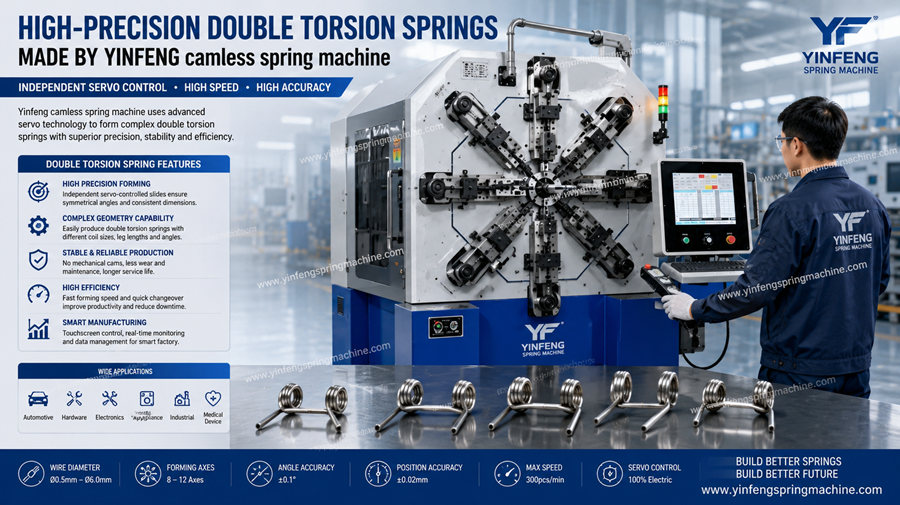
Why Choose a Camless Spring Machine?
Traditional cam-driven spring machines often require multiple mechanical adjustments to produce complex torsion springs.
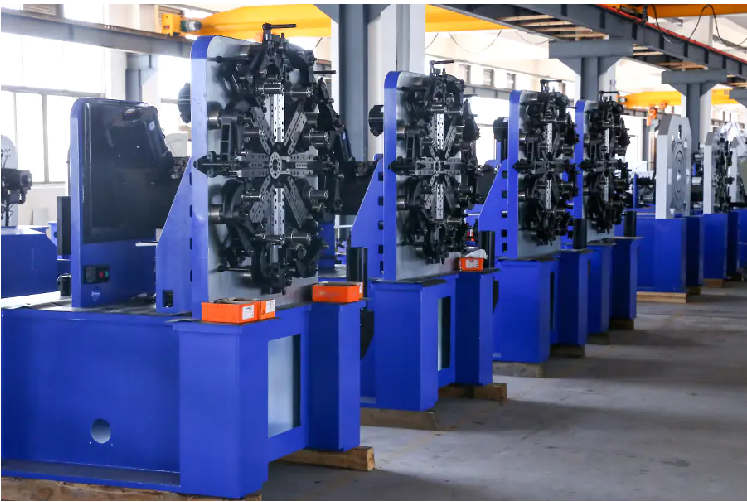
Camless spring machines eliminate mechanical cams and use independent servo-controlled slides instead.
This provides significant advantages for double torsion spring production.
Independent Servo Control
Each forming tool moves independently, allowing precise control of every forming step.
Higher Forming Accuracy
Digital servo positioning improves repeatability and reduces dimensional variation.
Faster Product Changeovers
New spring designs can be produced by loading different CNC programs instead of replacing mechanical cams.
Easier Product Development
Prototype springs can be developed and optimized more quickly.
Double Torsion Spring Manufacturing Process
The production process typically includes the following steps.
Step 1: Wire Feeding
The wire is fed into the machine through precision feed rollers.
Stable feeding ensures consistent spring dimensions.
Step 2: Coil Forming
The machine forms the first and second coils with precise diameter and pitch control.
Servo synchronization ensures both coils remain symmetrical.
Step 3: Center Bridge Forming
The bridge section connecting the two coils is accurately formed according to the product drawing.
Step 4: Leg Forming
Independent forming slides create the required leg angles and lengths.
Complex leg geometries can be produced without mechanical cam adjustments.
Step 5: Cutting
The finished spring is cut automatically with clean and consistent end quality.
Industries That Use Double Torsion Springs
Automotive Industry
Door lock mechanisms
Seat adjustment systems
Brake components
Interior hardware
Home Appliance Industry
Washing machines
Ovens
Refrigerators
Dishwashers
Furniture Industry
Hinges
Folding mechanisms
Adjustable chairs
Industrial Equipment
Mechanical linkages
Safety devices
Automation equipment
Agricultural Machinery
Latch systems
Lever mechanisms
Equipment assemblies
Advantages of Camless Spring Machines for Double Torsion Springs
Excellent Symmetry Control
Independent servo slides maintain consistent left and right coil geometry.
High Precision
Accurate positioning reduces dimensional variation between production batches.
Flexible Programming
Programs can be modified easily for different spring specifications.
Shorter Setup Time
Program changes replace mechanical cam replacement, significantly reducing setup time.
Better Production Efficiency
Faster changeovers allow manufacturers to process multiple product models efficiently.
Consistent Product Quality
Servo-controlled forming ensures repeatable production and stable spring performance.
How Yinfeng Camless Spring Machines Improve Production
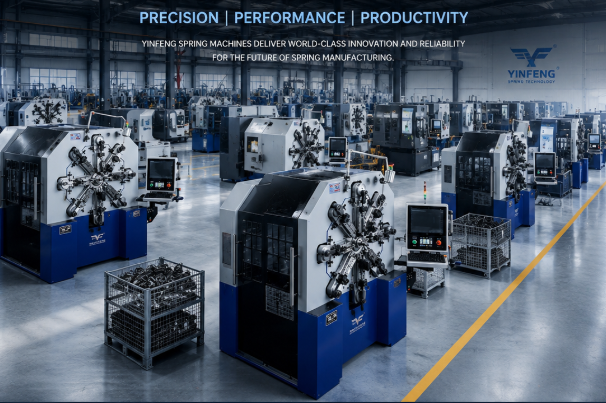
Yinfeng camless spring machines are designed specifically for demanding spring applications requiring flexibility and precision.
Key advantages include:
Independent multi-axis servo control
High-speed CNC operation
Stable wire feeding system
Easy program editing and storage
Quick product changeover
English and customized language support
Professional technical training and after-sales service
These features enable manufacturers to produce high-quality double torsion springs with greater efficiency and lower production costs.
Best Practices for Producing Double Torsion Springs
To achieve consistent quality, manufacturers should:
Use high-quality spring wire.
Inspect forming tools regularly.
Optimize CNC parameters through sample testing.
Verify coil symmetry and leg dimensions.
Perform routine machine calibration.
Save optimized production programs for repeat orders.
Following these practices helps improve accuracy and reduce scrap.
Conclusion
Double torsion springs require precise control of multiple forming dimensions, making them one of the most demanding spring products to manufacture. Camless spring machines provide the flexibility, precision, and efficiency needed to produce these complex springs with excellent repeatability.
For manufacturers seeking higher productivity, faster product development, and superior spring quality, Yinfeng camless spring machines offer an advanced and reliable solution for modern double torsion spring production.