



Common CNC Spring Machine Problems and How to Fix Them
Common CNC Spring Machine Problems and How to Fix Them
CNC spring machines are widely used in modern spring manufacturing due to their high precision, automation capabilities, and production efficiency. However, like any industrial equipment, CNC spring machines can experience operational issues that affect productivity, spring quality, and manufacturing costs.
Understanding the most common CNC spring machine problems and their solutions can help manufacturers minimize downtime, reduce material waste, and maintain consistent production quality.
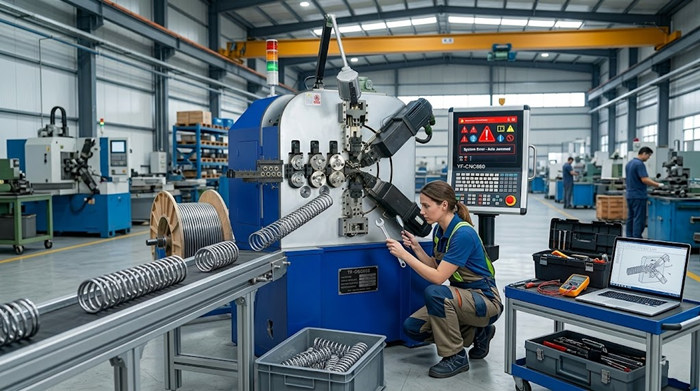
1. Wire Feeding Problems
Symptoms
Inconsistent wire feeding speed
Wire slipping during production
Irregular spring dimensions
Possible Causes
Worn feed rollers
Incorrect wire tension settings
Dirty feeding mechanisms
Poor wire quality
Solutions
Inspect and replace worn feed rollers.
Adjust wire tension according to material specifications.
Clean the feeding system regularly.
Use high-quality spring wire from reliable suppliers.
2. Spring Dimension Inaccuracy
Symptoms
Incorrect outer diameter
Uneven pitch
Inconsistent free length
Possible Causes
Programming errors
Tool wear
Servo motor calibration issues
Solutions
Verify CNC program parameters.
Inspect and replace worn tooling.
Perform routine machine calibration.
Conduct first-piece inspection before mass production.
3. Excessive Tool Wear
Symptoms
Rough spring surface
Reduced dimensional accuracy
Frequent machine adjustments
Possible Causes
Hard wire materials
Improper tool alignment
Lack of lubrication
Solutions
Use high-quality tooling materials.
Ensure correct tool positioning.
Follow recommended lubrication schedules.
Replace tools before excessive wear occurs.
4. Servo Motor Faults
Symptoms
Unexpected machine stoppages
Positioning errors
Alarm messages on the controller
Possible Causes
Electrical connection issues
Encoder malfunction
Overloaded motor
Solutions
Inspect wiring and connectors.
Check encoder performance.
Reduce excessive production loads.
Schedule preventive maintenance inspections.
5. Spring End Cutting Defects
Symptoms
Uneven cuts
Burrs on spring ends
Deformed spring shape
Possible Causes
Dull cutting tools
Incorrect cutting timing
Improper tool clearance
Solutions
Sharpen or replace cutting tools.
Optimize cutting parameters.
Verify cutter alignment and clearance settings.
6. Spring Shape Deformation
Symptoms
Bent or twisted springs
Poor product consistency
Possible Causes
Improper wire guiding
Incorrect tooling setup
Excessive machine vibration
Solutions
Adjust wire guide positions.
Reconfigure forming tools.
Inspect machine foundation and mounting stability.
7. Controller and Software Errors
Symptoms
Program interruptions
Data loss
Unexpected machine behavior
Possible Causes
Software bugs
Power fluctuations
Improper program modifications
Solutions
Keep software updated.
Use backup power systems.
Regularly back up CNC programs.
Train operators on correct programming procedures.
8. Excessive Machine Vibration
Symptoms
Noise during operation
Reduced spring accuracy
Premature component wear
Possible Causes
Loose machine components
Worn bearings
Unbalanced rotating parts
Solutions
Tighten machine fasteners.
Replace damaged bearings.
Balance moving components regularly.
Preventive Maintenance Tips
To reduce CNC spring machine failures, manufacturers should implement a preventive maintenance plan that includes:
Daily machine cleaning
Lubrication checks
Tool inspection and replacement
Servo system monitoring
Calibration verification
Software backups
Operator training
Conclusion
Most CNC spring machine problems can be prevented through proper maintenance, regular inspections, and correct machine setup. By identifying issues early and applying effective troubleshooting methods, manufacturers can improve productivity, reduce downtime, and maintain consistent spring quality.
A proactive maintenance strategy not only extends machine life but also ensures stable and efficient spring production for long-term business success.