


CNC Spring Machine Advantages: Why Modern Manufacturers Choose CNC Technology
CNC Spring Machine Advantages
As the spring manufacturing industry continues to evolve, more manufacturers are replacing traditional mechanical spring machines with CNC spring machines. CNC (Computer Numerical Control) technology has transformed the production of compression springs, extension springs, torsion springs, and wire forms by offering greater precision, efficiency, and flexibility.
Whether you operate a small workshop or a large-scale manufacturing facility, understanding the advantages of CNC spring machines can help you make a more informed investment decision.
What Is a CNC Spring Machine?
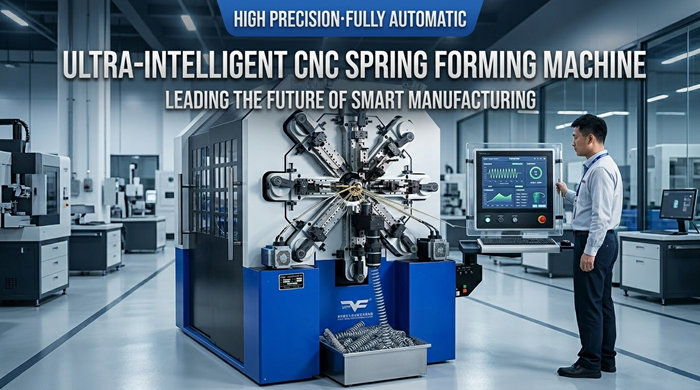
A CNC spring machine is an automated spring manufacturing system controlled by computer programs and servo motors. Unlike traditional cam-operated machines, CNC machines use digital controls to precisely manage wire feeding, coiling, pitch adjustment, cutting, and forming operations.
This advanced control system allows manufacturers to produce springs with greater accuracy and consistency.
1. Higher Precision and Accuracy
One of the biggest advantages of CNC spring machines is their exceptional precision.
Modern CNC systems can accurately control:
Wire feed length
Coil diameter
Spring pitch
Forming angles
Cutting position
As a result, manufacturers can consistently produce springs that meet strict dimensional tolerances.
Benefits
Improved product quality
Reduced dimensional variation
Better customer satisfaction
Compliance with industry standards
2. Faster Production Speed
CNC spring machines can operate at high speeds while maintaining consistent quality.
Automated servo systems perform multiple operations simultaneously, increasing overall production efficiency.
Benefits
Higher output
Shorter production cycles
Increased factory productivity
Reduced delivery times
This is particularly valuable for high-volume manufacturing environments.
3. Quick Product Changeovers
Traditional spring machines often require extensive mechanical adjustments when switching between products.
With a CNC spring machine, operators can simply load a new program and begin production.
Benefits
Reduced setup time
Faster response to customer orders
Efficient small-batch production
Greater manufacturing flexibility
Quick changeovers are especially important for custom spring production.
4. Ability to Produce Multiple Spring Types
A single CNC spring machine can often manufacture:
Compression springs
Extension springs
Torsion springs
Double torsion springs
Wire forms
This versatility allows manufacturers to serve multiple industries without investing in several dedicated machines.
Benefits
Expanded product offerings
Better equipment utilization
Lower capital investment
5. Reduced Labor Costs
Automation reduces the need for constant manual adjustments and supervision.
Many CNC spring machines can be operated by a single trained technician.
Benefits
Lower labor expenses
Reduced operator workload
Increased productivity per employee
Improved workplace efficiency
6. Improved Consistency and Repeatability
Every spring produced from the same CNC program follows identical parameters.
This ensures consistent quality from the first part to the last.
Benefits
Reliable production quality
Lower rejection rates
Reduced material waste
Easier quality control
Consistency is especially important in automotive, medical, and aerospace applications.
7. Advanced Multi-Axis Forming Capabilities
Modern CNC spring machines may include multiple servo-controlled axes.
Additional axes enable the production of:
Complex spring geometries
Custom wire forms
Three-dimensional bending shapes
Precision components
Benefits
Greater design flexibility
Ability to manufacture complex products
Reduced secondary processing
8. Lower Material Waste
Accurate control of wire feeding and forming operations helps minimize scrap.
Benefits
Improved material utilization
Lower production costs
Reduced environmental impact
Over time, reduced waste can significantly improve profitability.
9. Easier Program Storage and Reuse
CNC machines allow operators to store production programs digitally.
Programs can be recalled instantly whenever repeat orders are received.
Benefits
Faster production setup
Reduced programming errors
Improved production management
Simplified repeat manufacturing
10. Better Long-Term Return on Investment
Although CNC spring machines typically require a higher initial investment than traditional machines, they often provide a stronger return over time.
Savings come from:
Reduced labor costs
Higher production efficiency
Lower scrap rates
Improved product quality
Greater production flexibility
For many manufacturers, the productivity gains quickly offset the initial equipment cost.
Industries That Benefit from CNC Spring Machines
CNC spring machines are widely used in:
Automotive manufacturing
Aerospace engineering
Electronics production
Medical devices
Industrial equipment
Home appliances
Consumer products
Their flexibility makes them suitable for both mass production and custom manufacturing.
CNC Spring Machine vs Traditional Spring Machine
| Feature | CNC Spring Machine | Traditional Spring Machine |
|---|---|---|
| Precision | High | Moderate |
| Setup Time | Fast | Slow |
| Flexibility | Excellent | Limited |
| Labor Requirement | Low | Higher |
| Product Variety | Wide Range | Limited |
| Repeatability | Excellent | Moderate |
| Automation Level | High | Low |
Conclusion
CNC spring machines offer significant advantages over traditional spring manufacturing equipment. Their high precision, automation, flexibility, and efficiency enable manufacturers to improve product quality, reduce costs, and respond quickly to changing customer demands.
For companies seeking long-term competitiveness in the spring manufacturing industry, investing in CNC spring machine technology is often one of the most effective ways to increase productivity and support future growth.