



CNC Spring Machine vs Traditional Spring Machine: Key Differences, Advantages and Applications
A CNC Spring Machine and a Traditional Spring Machine are both used to manufacture springs, but they differ significantly in automation, precision, flexibility, and productivity.
Quick Comparison
| Feature | CNC Spring Machine | Traditional Spring Machine |
|---|---|---|
| Control System | Computer Numerical Control (CNC) | Mechanical cams, gears, and manual adjustments |
| Setup Time | Fast, software-based | Longer, requires physical cam changes |
| Precision | Very high and repeatable | Good, but more dependent on operator skill |
| Flexibility | Easily produces different spring designs | Best suited for long runs of the same design |
| Production Speed | High, especially for complex springs | High for simple, repetitive springs |
| Labor Requirement | Lower | Higher |
| Programming | Digital programs | Mechanical setup |
| Changeovers | Quick | Time-consuming |
| Complex Spring Shapes | Excellent capability | Limited capability |
| Initial Investment | Higher | Lower |
| Maintenance | Electronic and servo systems |
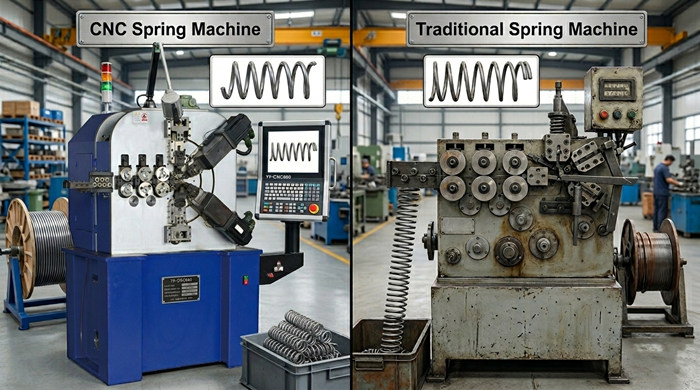
CNC Spring Machine
Advantages
Produces compression, extension, torsion, and custom-shaped springs with high accuracy.
Servo motors provide precise control over wire feed, coiling, pitch, and cutting.
Programs can be stored and reused.
Rapid switching between different spring models.
Reduced scrap and material waste.
Suitable for small batches and customized production.
Disadvantages
Higher purchase cost.
Requires programming knowledge and trained operators.
Electronic components can increase maintenance complexity.
Best For
High-precision industries such as automotive, aerospace, medical devices, and electronics.
Manufacturers producing many spring variants.
Traditional Spring Machine
Advantages
Lower initial cost.
Simpler mechanical design.
Easier for operators familiar with cam-based systems.
Reliable for producing large quantities of the same spring.
Disadvantages
Longer setup and adjustment times.
Less flexibility for design changes.
Greater dependence on operator skill.
More difficult to manufacture complex spring geometries.
Best For
High-volume production of a limited range of spring designs.
Operations where budget constraints outweigh flexibility requirements.
Cost Perspective
Although a CNC machine costs more upfront, it often provides:
Lower labor costs
Faster setup and changeovers
Reduced scrap rates
Better quality consistency
For manufacturers producing many different spring types, the return on investment (ROI) can be achieved relatively quickly.
Which One Should You Choose?
Choose a CNC Spring Machine if you need high precision, frequent design changes, automation, and complex spring geometries.
Choose a Traditional Spring Machine if you mainly produce large volumes of a few standard spring designs and want to minimize initial equipment costs.
For most modern spring manufacturers, CNC machines have largely become the preferred choice because of their flexibility and accuracy, while traditional machines remain valuable in certain high-volume, low-variation production environments.