


How Large Compression Springs Are Manufactured: Step-by-Step Production Process
How Large Compression Springs Are Manufactured
Large compression springs are essential components in many industries, including automotive, mining, railway, construction, energy, and heavy machinery. These springs are designed to withstand substantial loads, absorb shock, and provide reliable mechanical force in demanding applications.
Manufacturing large compression springs requires specialized equipment, high-quality materials, and precise production processes. This article explains how large compression springs are manufactured, from raw material preparation to final quality inspection.
What Is a Large Compression Spring?
A large compression spring is a helical spring designed to resist compressive forces. Compared with standard springs, large compression springs are produced from thicker wire or bar materials and are capable of handling significantly higher loads.
Typical applications include:
Truck suspension systems
Railway equipment
Mining machinery
Industrial presses
Construction equipment
Energy industry components
Step 1: Material Selection
The manufacturing process begins with selecting the appropriate spring material.
Common materials include:
High-carbon spring steel
Chrome silicon steel
Chrome vanadium steel
Stainless steel
Alloy spring steel
Material selection depends on:
Load requirements
Fatigue life expectations
Operating environment
Corrosion resistance needs
High-quality raw materials are critical to ensuring spring performance and durability.
Step 2: Wire or Bar Preparation
Large compression springs often use thick wire or steel bar stock.
Before coiling, the material may undergo:
Surface cleaning
Straightening
Lubrication
Dimensional inspection
Proper preparation helps ensure smooth forming and consistent spring geometry.
Step 3: CNC Coiling and Forming
The core manufacturing stage is spring coiling.
Modern manufacturers use large CNC spring machines to form the spring according to design specifications.
During this stage, the machine controls:
Wire feed length
Coil diameter
Spring pitch
Number of coils
Spring free length
Advanced servo-controlled systems ensure precise and repeatable production.
Hot Coiling vs Cold Coiling
The coiling method depends on material size.
Cold Coiling
Typically used for smaller and medium wire diameters.
Advantages:
High dimensional accuracy
Faster production
Lower energy consumption
Hot Coiling
Often used for large-diameter wire and heavy-duty springs.
The material is heated before forming, making it easier to shape and reducing forming stress.
Large industrial springs commonly use the hot coiling process.
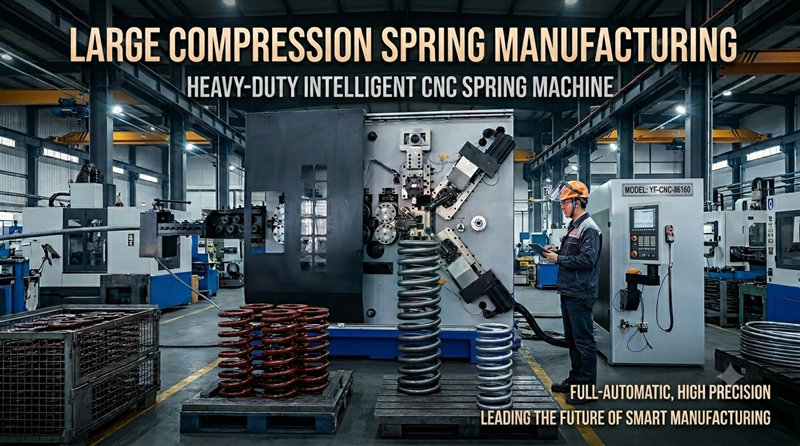
Recommended Equipment for Large Compression Spring Production
For manufacturers producing heavy-duty compression springs, choosing a machine with sufficient wire capacity and forming power is essential.
YF-CNC-86160 CNC Spring Machine is designed specifically for large spring manufacturing applications. The machine combines CNC automation, servo control technology, and heavy-duty construction to handle demanding production requirements.
Key advantages include:
Large wire diameter processing capability
High-precision servo control
Stable coiling performance
Fast product changeovers
Suitable for heavy-duty compression springs
Reliable operation for continuous industrial production
The machine is widely used in the production of springs for railway systems, mining equipment, construction machinery, and commercial vehicles.
Step 4: Heat Treatment
After coiling, springs undergo heat treatment to improve mechanical properties.
Heat treatment helps:
Relieve internal stress
Increase strength
Improve elasticity
Enhance fatigue resistance
The exact process varies depending on material type and application requirements.
Common methods include:
Stress relieving
Quenching
Tempering
Proper heat treatment is essential for long-term spring performance.
Step 5: End Grinding
Many compression springs require flat and square ends.
End grinding ensures:
Stable installation
Uniform load distribution
Improved performance
Grinding machines precisely machine the spring ends to achieve the required tolerances.
Step 6: Surface Treatment
Surface finishing improves durability and corrosion resistance.
Common treatments include:
Shot Peening
Benefits:
Improved fatigue life
Increased strength
Reduced crack formation
Powder Coating
Benefits:
Corrosion protection
Improved appearance
Zinc Plating
Benefits:
Rust resistance
Extended service life
The chosen treatment depends on the operating environment.
Step 7: Load Testing and Quality Inspection
Every spring must be inspected to ensure it meets specifications.
Typical inspections include:
Dimensional Inspection
Measurements include:
Outside diameter
Free length
Pitch
Wire diameter
Load Testing
Technicians verify:
Spring rate
Compression load
Deflection characteristics
Surface Inspection
Inspectors check for:
Cracks
Surface defects
Coating quality
Quality control is especially important for springs used in safety-critical applications.
Step 8: Packaging and Delivery
After inspection, springs are cleaned, labeled, and packaged for shipment.
Packaging methods may include:
Protective wrapping
Wooden crates
Industrial pallets
Custom export packaging
Proper packaging prevents damage during transportation.
Equipment Used in Large Compression Spring Manufacturing
Common equipment includes:
Large CNC spring machines
Hot coiling machines
Heat treatment furnaces
Grinding machines
Shot peening equipment
Spring testing machines
Quality inspection systems
These machines work together to ensure efficient and consistent production.
Advantages of CNC Manufacturing for Large Compression Springs
Modern CNC spring machines provide several benefits:
Higher accuracy
Faster setup
Better repeatability
Reduced material waste
Increased production efficiency
Flexible product changeovers
As a result, CNC technology has become the preferred solution for large compression spring manufacturing.
Conclusion
The manufacturing of large compression springs involves multiple critical stages, including material selection, coiling, heat treatment, grinding, surface finishing, and quality inspection. Each step plays an important role in ensuring the final spring delivers the required strength, durability, and performance.
With modern CNC spring machines and advanced production technologies, manufacturers can produce high-quality large compression springs that meet the demanding requirements of industries such as automotive, railway, mining, construction, and energy.