



Heavy-Duty Springs for Mining Equipment: Types, Materials, and Applications
Heavy-Duty Springs for Mining Equipment
Mining operations place enormous demands on machinery. Equipment must withstand constant vibration, heavy loads, impact forces, abrasive materials, and harsh environmental conditions. To ensure reliable performance and reduce downtime, mining equipment relies on high-quality heavy-duty springs.
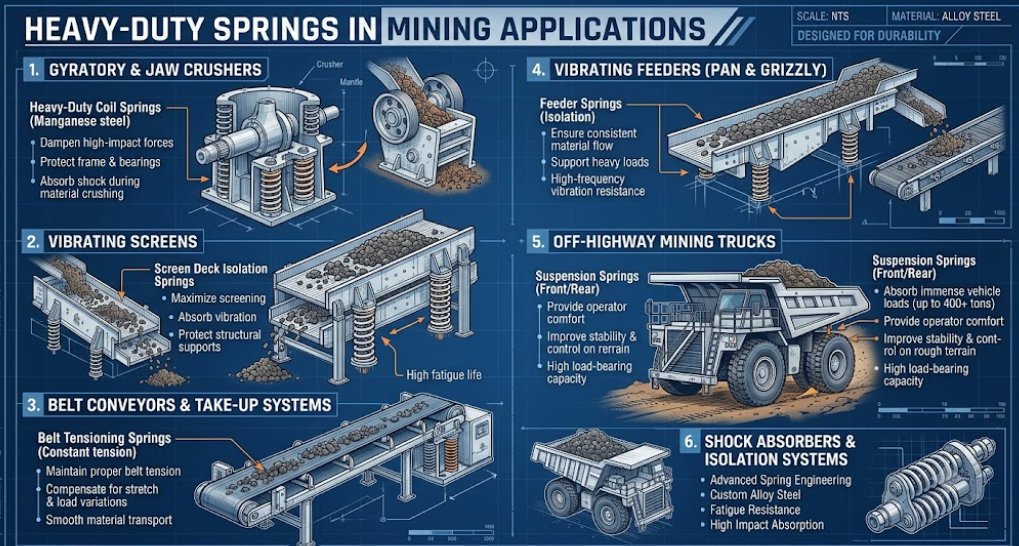
From crushers and vibrating screens to conveyors and material handling systems, heavy-duty springs play a critical role in absorbing shock, controlling movement, and protecting equipment from excessive stress.
Why Springs Are Important in Mining Equipment
Mining machinery operates under some of the most challenging conditions in any industry.
Heavy-duty springs help:
Absorb impact loads
Reduce vibration
Protect mechanical components
Improve equipment stability
Extend machine lifespan
Enhance operational safety
Without properly designed springs, excessive stress can lead to premature equipment failure and costly maintenance.
Common Types of Springs Used in Mining Equipment
Compression Springs
Compression springs are the most widely used spring type in mining applications.
Functions include:
Shock absorption
Load support
Vibration control
Force storage
Typical applications:
Crushers
Screening equipment
Heavy machinery suspension systems
Material handling equipment
Large compression springs are especially common in high-load mining environments.
Torsion Springs
Torsion springs provide rotational force and controlled movement.
Applications include:
Mechanical control systems
Access doors
Safety mechanisms
Industrial hinges
Extension Springs
Extension springs are used when tension force is required.
Applications include:
Conveyor systems
Equipment return mechanisms
Material handling components
Custom Engineered Springs
Many mining applications require custom-designed springs tailored to specific operating conditions and equipment requirements.
Mining Equipment That Uses Heavy-Duty Springs
Vibrating Screens
Vibrating screens separate and classify materials during processing.
Heavy-duty springs:
Support screen decks
Isolate vibration
Reduce structural stress
Because these systems operate continuously, spring fatigue resistance is critical.
Crushers
Crushers generate intense impact forces while processing rock and ore.
Springs are used to:
Absorb shock loads
Protect equipment components
Maintain operational stability
Heavy-duty compression springs are commonly found in cone crushers and other crushing systems.
Conveyors
Conveyor systems move materials throughout mining facilities.
Springs assist with:
Tension control
Vibration reduction
Equipment protection
Reliable spring performance helps minimize unplanned downtime.
Material Handling Equipment
Mining facilities use numerous material handling systems that rely on springs for controlled movement and load management.
Applications include:
Feeders
Hoppers
Transfer systems
Loading equipment
Suspension Systems
Large mining vehicles and mobile equipment often use heavy-duty suspension springs.
Benefits include:
Improved stability
Reduced vibration
Enhanced operator comfort
Better equipment protection
Best Materials for Mining Springs
Mining equipment requires materials that can withstand extreme conditions.
Chrome Silicon Steel
Chrome silicon steel is one of the most common choices for mining springs.
Advantages:
Excellent fatigue resistance
High load capacity
Long service life
Good heat resistance
Chrome Vanadium Steel
Chrome vanadium steel offers:
High strength
Excellent shock resistance
Superior durability
It is frequently used in heavy-load suspension and vibration applications.
Alloy Spring Steel
For specialized mining applications, alloy spring steels provide:
Exceptional strength
Improved wear resistance
Enhanced fatigue performance
Material selection should always match the specific operating environment and load requirements.
Key Design Factors for Mining Springs
Load Capacity
Mining springs must support substantial loads without permanent deformation.
Fatigue Life
Many mining machines operate continuously for extended periods.
High fatigue resistance is essential for minimizing maintenance interruptions.
Corrosion Resistance
Mining environments may expose springs to:
Moisture
Chemicals
Dust
Abrasive materials
Protective coatings and appropriate materials help improve durability.
Operating Temperature
Some mining operations involve elevated temperatures that affect material performance.
Engineers must consider temperature when selecting spring materials.
Manufacturing Heavy-Duty Mining Springs
Producing mining springs requires specialized equipment and strict quality control.
The manufacturing process typically includes:
Material selection
Wire preparation
Spring coiling
Heat treatment
Surface finishing
Load testing
Final inspection
Large compression springs for mining equipment are commonly manufactured using advanced CNC spring machines to ensure consistent quality and performance.
Recommended Machine for Mining Spring Production
Mining springs are often produced from large-diameter wire and require powerful forming equipment.
The YF-CNC-86160 Large CNC Spring Machine is designed for manufacturing heavy-duty compression springs used in demanding industries such as mining, railway, construction, and industrial machinery.
Key Benefits
Suitable for large wire diameters
CNC servo control technology
Stable coiling performance
High production efficiency
Reliable long-term operation
For manufacturers supplying the mining industry, machine stability and forming accuracy are essential to maintaining product quality.
Common Causes of Mining Spring Failure
Understanding failure mechanisms can help improve spring design and service life.
Common causes include:
Overloading
Exceeding the spring's design capacity.
Fatigue Failure
Repeated stress cycles eventually cause cracks.
Corrosion
Harsh environments can weaken spring materials.
Poor Material Selection
Using unsuitable materials for mining conditions.
Improper Heat Treatment
Incorrect processing can reduce strength and fatigue resistance.
Proper design and manufacturing help prevent these issues.
Conclusion
Heavy-duty springs are vital components in modern mining equipment. They absorb shock, control vibration, support loads, and protect machinery operating under extreme conditions.
By selecting the right materials, optimizing spring design, and using advanced CNC manufacturing equipment, mining equipment manufacturers can achieve longer service life, improved reliability, and reduced maintenance costs.
As mining operations continue to demand higher productivity and durability, high-quality heavy-duty springs remain an essential part of efficient equipment performance.