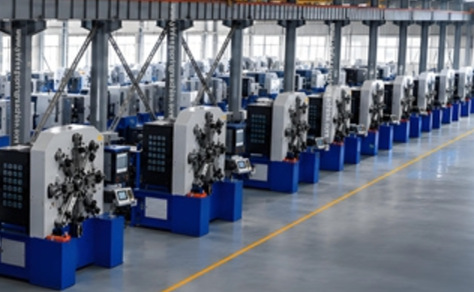
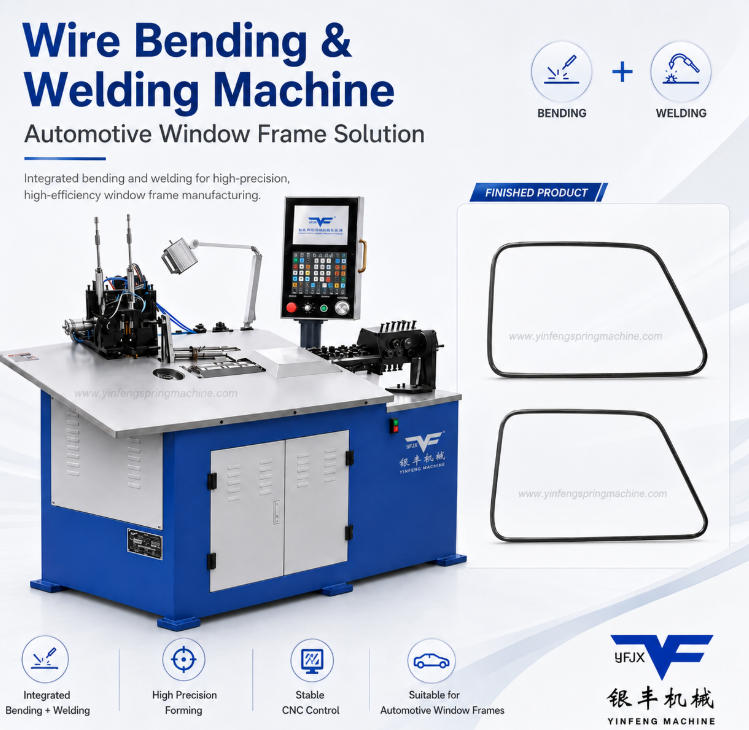
The Automatic 2D Wire Bending and Welding Machine is an integrated CNC production system developed for manufacturing planar and near-planar wire components that require both precision bending and welded joints.
Instead of bending a component on one machine and transferring it to a separate welding workstation, this solution can integrate wire feeding, straightening, length control, CNC 2D bending, frame positioning and welding into a coordinated manufacturing process.
The machine is suitable for manufacturing automotive wire frames, pickup truck window frames, support structures, guards, brackets, closed wire frames, display components and other customized welded wire products.
Its flexible CNC programming system allows manufacturers to produce different wire geometries by changing production programs and corresponding tooling, making the machine suitable for both customized production and repeat batch manufacturing.
Modern welded wire components often require more than simple bending.
A typical product may contain:
Multiple straight sections
Different bending angles
Radius corners
Long and short side sections
Symmetrical geometry
Closed or semi-closed structures
Precisely positioned joining ends
One or more welded joints
Producing these parts with separate straightening, bending, positioning and welding operations can increase manual handling and make dimensional consistency more difficult to control.
The Yinfeng 2D wire bending and welding solution integrates these processes into a more efficient production system.
The final machine configuration is developed according to the customer's wire diameter, material, product dimensions, bending geometry, welding position, tolerance requirements and target production capacity.
The wire feeding system accurately delivers the required material length according to the programmed forming sequence.
Stable wire feeding is essential for controlling:
Overall product dimensions
Straight-section length
Bend position
Joining position
Product repeatability
Wire from a coil normally contains residual curvature.
Before forming, the wire passes through a straightening system to improve material consistency and prepare it for accurate bending.
Proper straightening helps improve:
Frame flatness
Straight-section accuracy
Bend positioning
Welding alignment
Final dimensional consistency
Servo-controlled bending tools form the wire according to the programmed geometry.
Depending on the product design, the machine can create:
90-degree bends
Acute-angle bends
Obtuse-angle bends
Radius corners
Repeated bends
Symmetrical structures
Long straight sections
Rectangular and polygonal frames
Closed wire structures
Semi-closed wire components
Custom planar wire shapes
The exact forming capability depends on wire material, wire diameter, bend radius, part dimensions and tooling configuration.
After the bending sequence, the component can be positioned so that the joining ends reach the required welding location.
Accurate positioning is especially important for closed-frame components because small dimensional errors during bending can affect the final welding joint.
The welding system joins the required wire ends or connection points after bending and positioning.
Integrating welding with wire bending helps reduce the need to manually transfer formed parts between separate production stations.
Depending on the product, wire material and joint requirements, the welding configuration can be customized for the actual manufacturing application.
Different product programs can be created, saved and recalled.
This is particularly useful for manufacturers producing several wire-frame models or repeat customer orders.
Programs can include parameters such as:
Wire feeding length
Bend sequence
Bend angle
Bend position
Forming speed
Positioning sequence
Welding sequence
Product-specific process settings
The Automatic 2D Wire Bending and Welding Machine is not limited to one specific product.
It can be configured for a wide range of planar and near-planar welded wire components.
Typical automotive applications include:
Automotive Window Frames
Pickup Truck Window Frames
Commercial Vehicle Window Frames
Side Window Support Frames
Rear Window Wire Frames
Door Window Support Frames
Automotive Reinforcement Wire Frames
Seat Support Wire Frames
Headrest Wire Frames
Vehicle Support Wire Structures
Automotive Wire Brackets
Custom Welded Automotive Wire Components
The system can also be configured for:
Welded Wire Frames
Equipment Support Frames
Machine Protection Frames
Structural Wire Frames
Closed Industrial Wire Components
Reinforcement Frames
Equipment Mounting Frames
Custom Industrial Wire Structures
Typical products may include:
Protective Wire Guards
Fan Guards
Machine Safety Guards
Equipment Protection Frames
Lighting Protection Frames
Appliance Protection Frames
Custom Safety Wire Structures
Final manufacturability should be evaluated according to product geometry and safety requirements.
Suitable products can include:
Mounting Brackets
Support Brackets
Retaining Frames
Wire Holders
Equipment Supports
Appliance Support Components
Automotive Support Components
Industrial Mounting Wire Parts
Depending on product size and configuration, the machine may also be used for:
Display Rack Frames
Retail Display Wire Components
Shelf Support Frames
Storage Rack Wire Parts
Hanging Display Components
Welded Retail Wire Structures
One of the most suitable application groups is wire products that require a continuous shape and a welded closing joint.
Examples include:
Rectangular Wire Frames
Polygonal Wire Frames
Custom Closed Frames
Reinforcement Rings with Formed Sections
Welded Support Structures
Custom OEM Wire Components
The machine can serve manufacturers in industries such as:
Automotive
Commercial Vehicles
Agricultural Equipment
Household Appliances
Industrial Equipment
Furniture
Retail Display Systems
Storage Equipment
Hardware
Lighting
Metal Fabrication
Custom Wire Products
Traditional welded wire-frame manufacturing may involve several independent steps:
Wire straightening
Wire cutting
CNC or manual bending
Component unloading
Manual transfer
Fixture loading
Joint positioning
Welding
Finished-part unloading
Inspection
An integrated wire bending and welding machine can shorten this production flow.
The formed component does not need to be repeatedly moved between independent bending and welding workstations.
Controlled positioning helps align the wire ends before welding.
Integrating multiple manufacturing stages can reduce the number of separate positioning operations.
CNC feeding and bending programs can repeatedly reproduce the same part geometry.
Operators mainly manage programs, material, tooling and production monitoring instead of manually forming each component.
Stored programs can be recalled when the same product is manufactured again.
The customer's drawing is evaluated to determine:
Wire diameter
Wire material
Overall dimensions
Straight-section lengths
Bend positions
Bend angles
Bend radii
Welding locations
Joint design
Tolerance
Target output
Suitable wire material is loaded into the feeding system.
Material characteristics such as tensile strength, surface coating and weldability should be considered before production.
The wire is straightened to reduce residual curvature from the wire coil.
The servo feeding system delivers the programmed wire length for each forming operation.
The bending system creates the required planar geometry according to the stored CNC program.
Successive feeding and bending movements create the final frame or component shape.
The joining sections are accurately positioned for welding.
Customized fixtures hold the part in the required position before and during welding.
The required joint is welded according to the product and material specification.
The completed component is released from the production system.
The finished part can be inspected for geometry, welding quality and dimensional consistency.
Depending on the product geometry and welding method, suitable materials may include:
Low-Carbon Steel Wire
Carbon Steel Wire
Stainless Steel Wire
Galvanized Steel Wire
Automotive Structural Wire
Weldable Alloy Wire
Customer-Specified Metal Wire
Material selection should consider:
Tensile strength
Bending formability
Weldability
Surface coating
Corrosion resistance
Required mechanical strength
Final product application
Customer quality requirements
The actual material should be tested and confirmed according to the product drawing and welding process.
Different wire products require different welding processes.
The welding solution should therefore be configured according to:
Wire material
Wire diameter
Joint type
Contact area
Required weld strength
Surface appearance
Production speed
Product positioning
Heat input
Customer welding specification
Yinfeng can evaluate the required bending and welding process based on customer drawings and product samples.
Reliable tooling is essential for stable bending and welding production.
Depending on the product, tooling can include:
Wire Guides
Straightening Rollers
Bending Tools
Forming Dies
Positioning Fixtures
Welding Clamps
Support Fixtures
Anti-Deformation Fixtures
Product Inspection Gauges
Customized tooling helps control product dimensions while maintaining stable positioning during welding.
Welding introduces localized heat into the wire component.
For precision wire frames, uncontrolled heat input can cause dimensional changes or frame distortion.
Important control factors include:
Correct fixture design
Stable clamping
Accurate joint positioning
Controlled welding energy
Suitable welding sequence
Consistent material quality
Correct product support
Post-weld dimensional inspection
For products with strict dimensional requirements, sample testing should be completed before mass production.
The CNC control system allows operators to manage the main production parameters from the machine interface.
Typical programmable functions include:
Wire feed length
Feed speed
Bending angle
Bend sequence
Bending position
Forming speed
Positioning action
Welding sequence
Product-specific settings
Completed programs can be saved and reused for future production.
Chinese and English interfaces are available as standard, and additional interface languages can be customized according to customer requirements.
One machine can be used for different compatible wire products by changing:
CNC program
Bending tooling
Positioning fixtures
Welding fixtures
Product-specific settings
This makes the equipment suitable for manufacturers producing multiple product models.
Actual compatibility between different products should be confirmed before machine configuration.
Wire bending and welding are combined into one coordinated manufacturing solution.
The machine can be developed for different automotive and industrial welded wire components instead of being limited to only one window-frame design.
Servo-controlled feeding and bending help maintain consistent geometry during repeat production.
Production programs can be saved and recalled for repeat orders.
Automated forming and welding can reduce repeated manual transfer and positioning.
Tooling and fixtures can be designed around the customer's actual product drawing.
The system can be developed for vehicle-specific, industrial and custom wire-frame components.
Because this is a customized bending and welding solution, final specifications should be determined from the customer's product.
| Evaluation Item | Configuration Basis |
|---|---|
| Wire Diameter | According to product drawing and material |
| Wire Material | Carbon steel, stainless steel, galvanized or other weldable wire |
| Product Geometry | Primarily planar or near-planar wire components |
| Bending Angles | According to customer drawing |
| Bend Radius | According to wire diameter and product design |
| Welding Position | According to joint structure |
| Welding Method | Selected according to material and joint requirements |
| Tooling | Customized according to product |
| Positioning Fixture | Customized according to component geometry |
| CNC Program | Product-specific |
| Production Speed | Evaluated according to geometry and process |
| Control Language | Chinese / English standard; additional languages customizable |
Important: Final machine configuration cannot be determined by wire diameter alone. Product dimensions, material strength, bend radius, welding joint, tolerance, tooling arrangement and required production speed must also be evaluated.
The Automatic 2D Wire Bending and Welding Machine is suitable for:
Automotive component manufacturers
Commercial vehicle parts suppliers
Wire-frame manufacturers
Metal fabrication companies
Industrial wire-product factories
Appliance component manufacturers
Retail display manufacturers
Hardware manufacturers
OEM wire-component suppliers
Custom wire forming companies
Automotive and pickup truck window frames remain one of the important applications of this machine.
For primarily planar window-frame structures, CNC 2D bending can control the straight sections, corners, radii and joining locations before the frame is positioned and welded.
Customers specifically interested in this application can refer to Yinfeng's:
Automotive Window Frame Manufacturing Solution | 2D Wire Bending & Welding Machine
This dedicated Industry Solution explains the production requirements, process design, welding deformation control and quality considerations for pickup truck and commercial vehicle window-frame manufacturing.
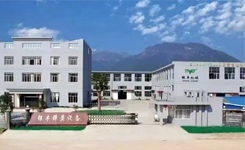
Zhejiang Yinfeng Automation Technology Co., Ltd. provides CNC wire bending, wire forming and customized automation solutions based on actual customer products and manufacturing requirements.
Our project support can include:
Product drawing evaluation
Machine configuration
Forming-process development
Welding-system integration
Customized tooling
Customized fixtures
Sample production
CNC programming support
Factory acceptance testing
Operator training
Installation guidance
Spare-parts support
Long-term technical assistance
Instead of selecting equipment based only on a general machine specification, Yinfeng evaluates the actual product structure and develops a production solution around the customer's manufacturing requirements.
For an accurate technical proposal, please provide:
2D or 3D product drawing
Product photos
Physical sample if available
Wire diameter
Wire material
Overall dimensions
Bend angles
Bend radii
Welding positions
Joint structure
Required welding method if specified
Dimensional tolerance
Target production speed
Annual production quantity
Surface requirements
Based on this information, Yinfeng can evaluate the bending process, welding solution, tooling, fixture system and machine configuration.
A 2D wire bending and welding machine is a CNC system that forms primarily planar wire components and integrates a welding process for joining required wire ends or connection points. It can combine feeding, straightening, bending, positioning and welding within one production solution.
Typical products include automotive window frames, pickup truck window frames, support frames, wire guards, brackets, equipment frames, display frames and other custom planar welded wire components.
No. Automotive window frames are one important application, but the machine can also be configured for many industrial, appliance, hardware, display and custom welded wire-frame products.
Yes. The production system can integrate CNC bending, positioning and welding according to the required machine configuration and product design.
Yes. Suitable products can be bent into closed or near-closed geometries and joined at the required welding point. Actual manufacturability depends on the component design and tooling arrangement.
Yes. Different compatible products can be produced by changing CNC programs and, when necessary, tooling and positioning fixtures.
Suitable materials may include low-carbon steel, carbon steel, stainless steel, galvanized steel and other weldable metal wire. Final suitability depends on the material properties and welding requirements.
Yes. CNC programs can be stored and recalled for repeat production, reducing setup work for returning orders.
Yes. The welding configuration can be developed according to the wire material, joint structure, required weld strength, surface quality and production process.
Yes. Customers can provide drawings or samples for evaluation. Bending tooling, positioning fixtures and welding clamps can be developed according to the actual product.
A 2D machine is normally suitable when the main product geometry lies in one plane or is predominantly planar. Components with significant out-of-plane bends or complex spatial geometry may require a 3D wire bending solution.
Yes. Machine operation, programming, tooling adjustment and basic maintenance training can be provided according to the project and service arrangement.
Automotive Window Frames
Pickup Truck Window Frames
Commercial Vehicle Wire Frames
Automotive Seat Support Frames
Headrest Wire Frames
Protective Wire Guards
Industrial Support Frames
Welded Wire Brackets
Display Rack Frames
Custom Closed Wire Components
CNC 2D Wire Bending Machine
CNC 3D Wire Bending Machine
Automatic Wire Forming Machine
Customized Wire Bending and Welding System
Automotive Window Frame Manufacturing Solution
Automotive Seat Frame Manufacturing Solution
Automotive Headrest Frame Manufacturing Solution
Commercial Vehicle Wire Frame Manufacturing Solution
Custom Welded Wire Frame Manufacturing Solution
Do you need to manufacture a welded wire frame, automotive component, bracket, guard or other customized 2D wire product?
Send Yinfeng your product drawing, wire diameter, material, bending geometry, welding requirements, tolerance and target production speed.
Our engineering team can evaluate the complete manufacturing process and recommend a suitable CNC wire bending, tooling, positioning and welding solution for your application.