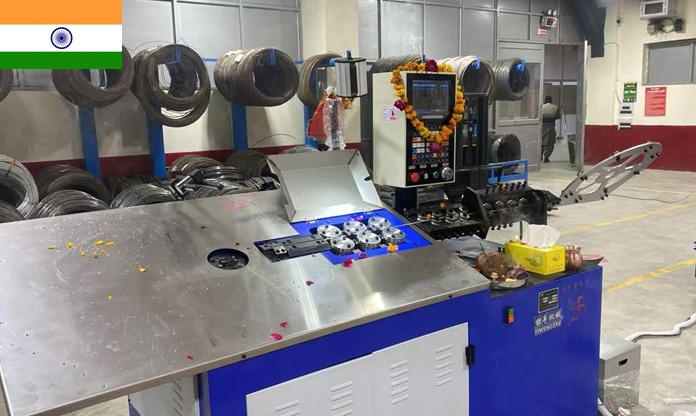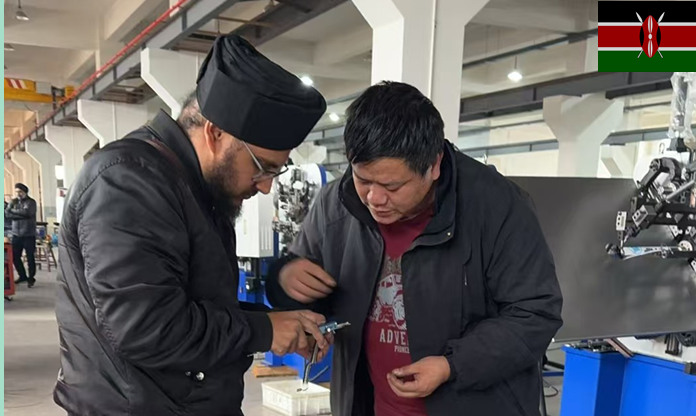
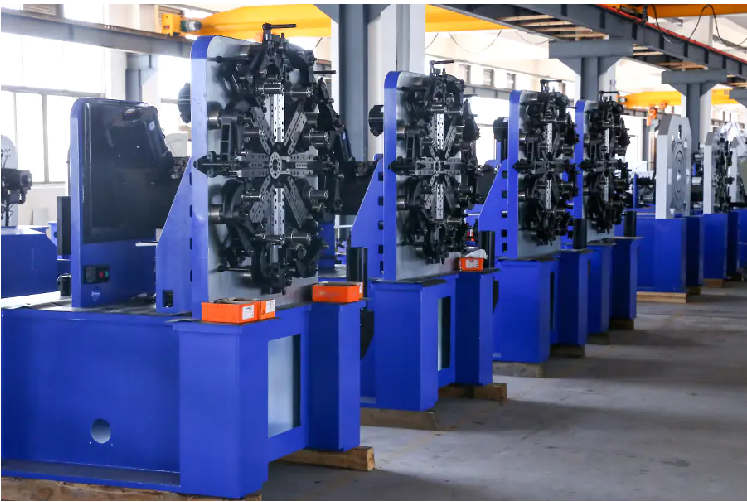
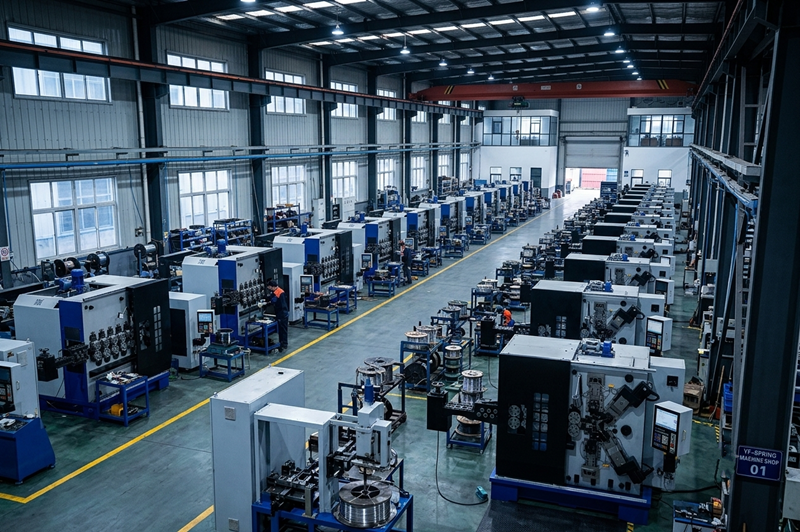
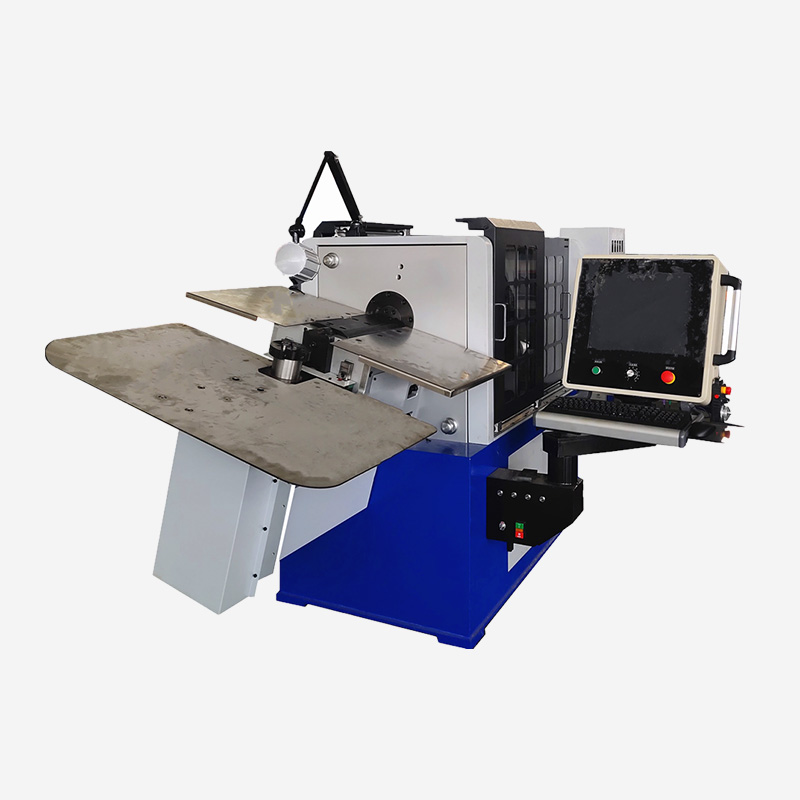
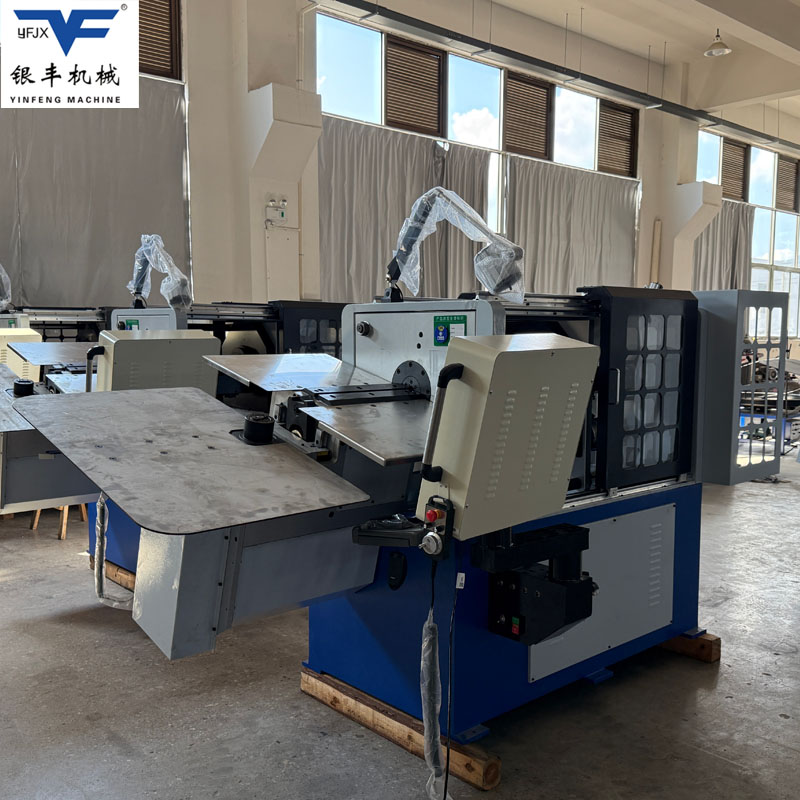
The YF-3D-7-60 is developed for manufacturers producing compact three-dimensional wire components
that require accurate feeding, controlled wire rotation and repeated changes between different bending planes.
Its 7-axis CNC configuration coordinates wire feeding, bending-head movement, tooling rotation,
wire orientation and cutting within one programmed cycle. This enables the machine to form components that cannot
be completed efficiently on a conventional planar wire bender.
With an applicable wire range of Ø2.0–6.0 mm, the machine is particularly suitable for automotive interior mechanisms,
electrical equipment, household appliances, precision machinery and customized industrial hardware.
| Model | YF-CNC-7-60 |
| Wire diameter | Φ2mm-6mm |
| Axles number | 7 axles |
| Wire feed length | Infinite |
| Wire feed speed | 100Meter/Mln |
| Wire Feed instruction value | ±0.01 - ± 9999.99 |
| Input voltage | 380V±10%V50HZ (Customized) |
| Cam instruction value | ±0.1° - ±359.9° |
| Wire feed shaft servo power | 2.7kw |
| Wire-switching shaft servo power | 1.2kw |
| Torsion shaft servo power | 1.2kw |
| Lifting platform servo power | 0.75kw |
| Cut shaft servo motor | 0.75kw |
| Torsion lifting servo power | 0.75kw |
| Core-switching shaft servo power | 1.2kw |
| Machine weight | 2000KG |
| Machine sizes | 2900cm*1900mm*1700mm |
3D Wire forming machine which owns the following characteristics:
1) Adopt the high capacity processor and high accuracy motion controllable module; rapid calculation
speed and high reliability; up to 500 pieces/min. for the machining velocity;
2) Seven shafts servo control; it may be extended to eight shafts and supported the
synchronization/single control;
3) Both the type and the top speed of servo shaft are set by parameter, and support the parameter
backup;
4) Display interface with Chinese, adjustment luminance, support the automatic screensaver;
5) Tabular programming, simple and facility, support the Teaching programming and the direct program
record of axis coordinate;
6) It owns the testing knob and MPG trial debugging process function, which can be performed the
real-time modification program during the test;
7) 32M super-space of program, up to 10000 programs can be memorized;
8) It owns the USB interface and supports the file copy and software upgrading;
9) 24-point input, support the detection input with high-speed probe, winding of the wire-feeding shelf,
alarm detection input with wire-break and wire-deviation;
10) 16-point output, and support the 8-group air cylinder, coil-holder acceleration output;
11) Support the coil-holder frequency-converter speed control;
12) Support the multi-level authority administration, own the controller locking and parameter
protection function;
13) It can be customized the Power-on screen, screensaver and manufacturer name and LOGO
display.
Function: Controls the rotation angle of the bending.
Purpose: The X-axis increases the flexibility of the bends, allowing for more complex bending operations. It enables the bend to rotate in different directions to achieve multi-angle bending.
Function: Controls the feeding length of the wire.
Purpose: The Y-axis accurately feeds the wire into the bending area, ensuring the position of each bending point is accurate. This forms the foundation of the entire forming process, determining the final product's dimensions and shape.
Function: Controls the cutting action of the cutter.
Purpose: The Z-axis achieves wire cutting by controlling the cutter's movement. It can precisely cut the wire, ensuring the position and quality of each cut.
Function: Controls the up-and-down movement of the bending tool.
Purpose: The A-axis applies pressure through up-and-down movement to achieve wire bending. It can perform precise bending operations according to the set bending angle and force, ensuring the accuracy of each bending angle.
Function: Controls the up-and-down movement of the tray.
Purpose: The B-axis adjusts the height of the tray, providing proper support and positioning for the wire. It ensures the wire's position is stable during bending and supports the creation of complex 3D structures.
Function: Controls the rotational angle of the mold.
Purpose: The C-axis, in conjunction with the bending head, controls the rotational angle of the mold to achieve bends at different angles and directions, increasing the diversity and precision of the bending.
Function: Controls the rotational angle of the wire.
Purpose: The U-axis can adjust the wire's direction, allowing for bending operations on different planes. This function enables the forming machine to create complex 3D wire structures.
The YF-3D-7-60 is designed for producing compact and medium-sized three-dimensional wire components from Ø2.0–6.0 mm wire.
Its seven-axis configuration coordinates wire feeding, wire rotation, bending-head movement, tooling rotation and cutting, allowing the wire to be formed across multiple planes within one programmed production cycle. This makes the machine suitable for parts that require more spatial complexity than conventional flat wire bending.
The YF-3D-7-60 can be configured to produce:
Automotive locking rods
Seat adjustment wire components
Small headrest support wires
Three-dimensional retaining clips
Electrical cabinet wire brackets
Appliance mechanism links
Precision wire handles
Small protective wire guards
Equipment positioning rods
Multi-angle wire hooks
Compact support frames
Custom 3D wire components
This model is particularly suitable for automotive interior components, electrical equipment, household appliances, precision machinery and general industrial hardware.
Its Ø2.0–6.0 mm range makes it more appropriate for compact parts, controlled bending radii and detailed multi-angle geometries than for very large structural frames.
Final manufacturability depends on wire material, tensile strength, overall part dimensions, number of bends, plane changes, minimum bending radius, straight-section length and tolerance requirements.