


Wire Form Tolerances Explained: Factors, Standards, and Best Practices
Precision Tolerances in Wire Form Manufacturing: A Complete Guide
Precision is one of the most important factors in wire form manufacturing. Whether producing automotive retainers, medical components, electronic clips, or industrial wire parts, maintaining tight tolerances ensures product functionality, assembly compatibility, and consistent quality.
This guide explains what wire form tolerances are, the factors that influence them, and how modern CNC wire forming machines achieve high levels of accuracy.
What Are Wire Form Tolerances?
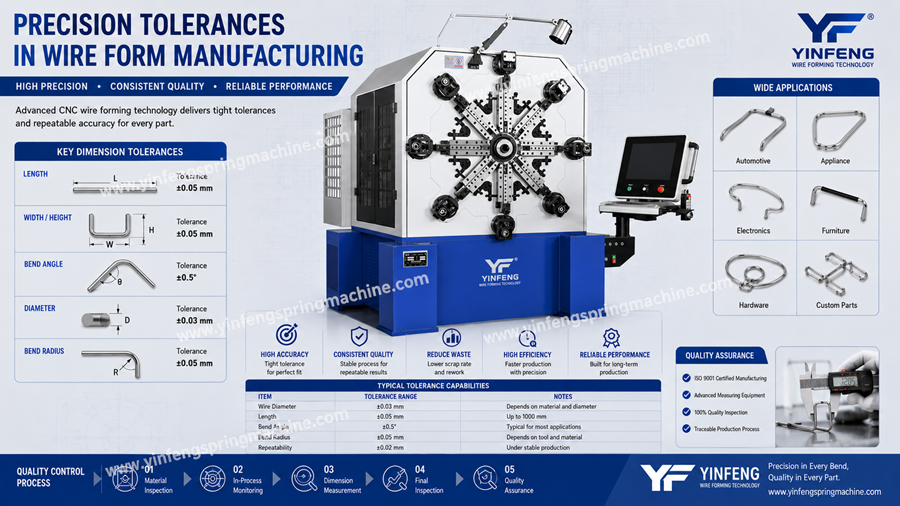
Wire form tolerances refer to the allowable variation between the designed dimensions of a wire part and the actual manufactured dimensions.
No manufacturing process can produce parts with absolutely perfect dimensions. Therefore, acceptable dimensional ranges are established to ensure that finished products meet functional and quality requirements.
Typical tolerance considerations include:
Overall length
Width and height
Bend angles
Hole positions
Radius dimensions
Form geometry
Symmetry and alignment
The required tolerance depends on the application and industry standards.
Why Are Tight Tolerances Important?
Precision tolerances directly affect product performance.
Proper Assembly
Wire forms must fit correctly with mating components.
Product Reliability
Accurate dimensions help ensure consistent mechanical performance.
Reduced Production Waste
Maintaining tolerances minimizes rejected parts and rework.
Customer Satisfaction
Consistent quality improves product reliability and customer confidence.
For industries such as automotive and medical manufacturing, tolerance control is especially critical.
What Factors Affect Wire Form Tolerances?
Several variables influence the final accuracy of wire forms.
Material Properties
Different wire materials behave differently during forming.
Factors include:
Tensile strength
Hardness
Elasticity
Springback characteristics
Materials with higher springback often require compensation during programming.
Wire Diameter
Larger wire diameters generally require greater forming force and may result in slightly wider tolerance ranges.
Smaller diameter wires often allow tighter dimensional control.
Part Complexity
Simple wire forms can usually achieve tighter tolerances than highly complex three-dimensional parts.
Products with multiple bends and rotations may experience cumulative dimensional variation.
Machine Accuracy
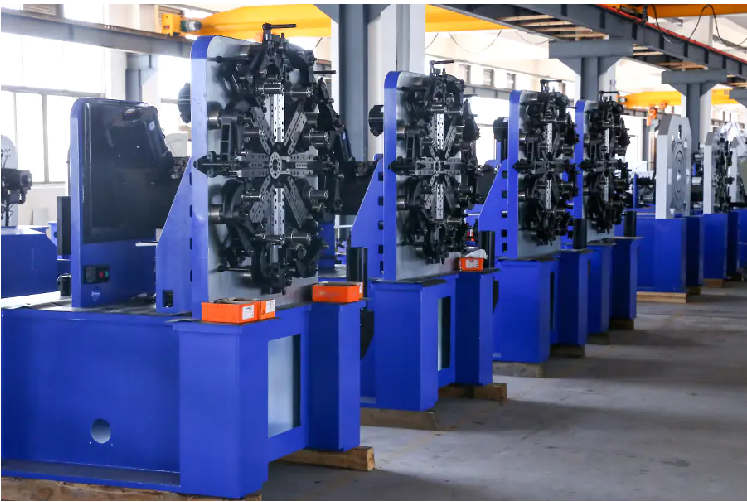
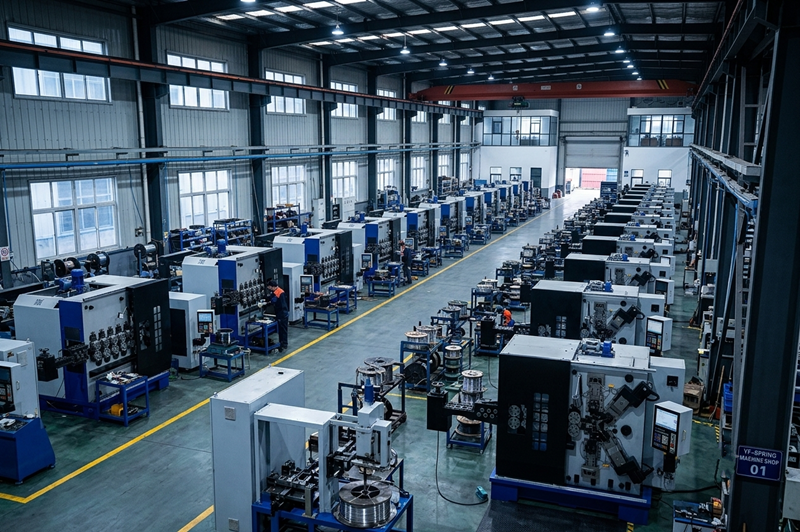
Modern CNC wire forming machines use servo-controlled systems that provide highly repeatable positioning and movement.
Machine quality directly influences manufacturing precision.
Tool Condition
Worn or damaged forming tools can cause dimensional deviations.
Regular tool inspection is essential for maintaining accuracy.
Operator Experience
Proper machine setup and parameter optimization contribute significantly to tolerance control.
What Tolerances Can CNC Wire Forming Machines Achieve?
Actual tolerances vary depending on:
Wire diameter
Material type
Product geometry
Machine configuration
Modern CNC wire forming machines are capable of producing highly consistent wire forms suitable for demanding industrial applications.
For many products, manufacturers can achieve excellent repeatability through:
Precision servo control
Stable wire feeding systems
Advanced programming
Regular calibration
Specific tolerance requirements should always be evaluated based on the product drawing and production conditions.
How Does Springback Affect Accuracy?
Springback occurs when wire material partially returns toward its original shape after bending.
This is one of the biggest challenges in wire form manufacturing.
Factors affecting springback include:
Material type
Wire diameter
Bend angle
Forming speed
Experienced manufacturers compensate for springback through parameter adjustments and production testing.
Proper compensation improves dimensional consistency and reduces rejected parts.
How Is Wire Form Accuracy Measured?
Quality control typically involves:
Calipers
Used to measure linear dimensions.
Angle Gauges
Verify bend angles and geometry.
Custom Inspection Fixtures
Ensure critical dimensions remain within specification.
Coordinate Measuring Machines (CMM)
Used for high-precision applications requiring detailed dimensional verification.
Regular inspection helps maintain process stability and product quality.
Best Practices for Maintaining Tight Tolerances
Manufacturers can improve accuracy by following several best practices.
Use High-Quality Materials
Consistent material quality reduces variation.
Maintain Forming Tools
Replace worn tools before dimensional issues occur.
Perform Regular Calibration
Machine calibration ensures repeatable positioning accuracy.
Optimize Programs
Fine-tuning parameters improves consistency.
Conduct First-Article Inspection
Verify dimensions before mass production begins.
Monitor Production Continuously
Regular quality checks prevent large batches of non-conforming parts.
Industries Requiring High-Precision Wire Forms
Automotive Industry
Retainers, clips, and safety-related components.
Medical Industry
Surgical instruments and precision wire assemblies.
Electronics Industry
Connectors and conductive components.
Aerospace Industry
Lightweight precision parts requiring strict quality standards.
Industrial Equipment
Custom wire forms used in machinery and assemblies.
These industries often require tight dimensional control and reliable repeatability.
How Yinfeng Supports Precision Manufacturing
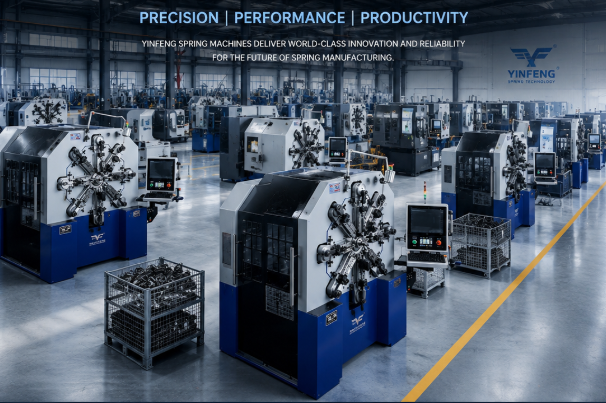
Yinfeng CNC wire forming machines are designed to deliver stable and accurate production through:
High-precision servo systems
Advanced CNC control technology
Stable wire feeding mechanisms
Program storage and reuse
Easy parameter adjustment
Technical support and training
These features help manufacturers improve consistency and achieve demanding quality requirements.
Conclusion
Precision tolerances are critical to the success of wire form manufacturing. Material properties, machine accuracy, tooling condition, and process control all play important roles in determining final product quality.
By combining modern CNC wire forming technology with proper maintenance and quality control procedures, manufacturers can achieve consistent, reliable, and highly accurate wire form production for a wide range of industries.