



Introduction to Spring Tolerance Standards
Introduction to Spring Tolerance Standards
Spring Tolerance Standards refer to the technical specifications that define the allowable deviations for various spring parameters during the design, manufacturing, and quality inspection processes. These parameters include dimensions, load, spring rate, free length, number of coils, squareness, and surface quality. The primary purpose of these standards is to ensure consistent performance and interchangeability among different production batches, while meeting assembly and operational requirements. Commonly recognized international spring tolerance standards include DIN 2095 (German Standard), EN 15800 (European Standard), JIS B2704 (Japanese Industrial Standard), and SMI (Spring Manufacturers Institute) standards.
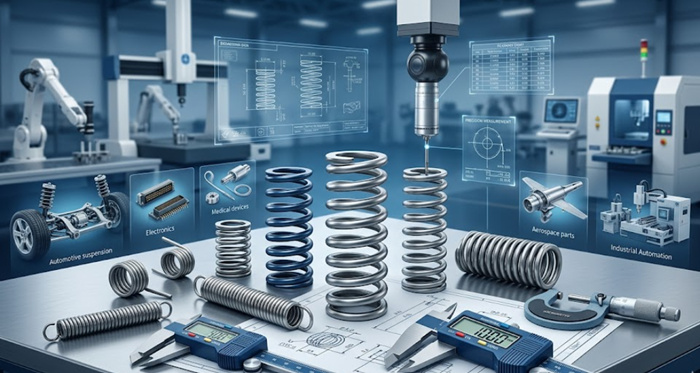
In the automotive industry, springs are widely used in suspension systems, clutches, braking systems, and engine components. Due to the stringent requirements for vehicle safety and durability, spring tolerances are typically tightly controlled. For example, suspension compression springs require not only precise load tolerances but also strict control of free length and spring rate to ensure consistent vehicle handling and performance.
In the electronics and consumer products industry, springs are commonly used in connectors, battery contacts, button mechanisms, and precision switches. These applications often involve small-sized precision springs, making wire diameter, outer diameter, and force tolerances critical factors in ensuring the long-term reliability and stable operation of electronic devices.
In the medical device industry, springs are used in syringes, surgical instruments, implantable devices, and diagnostic equipment. Because these products directly impact patient safety, they must meet not only dimensional and force tolerance requirements but also standards related to biocompatibility, material traceability, and cleanliness. As a result, manufacturing precision is significantly higher than that required for general industrial products.
In the aerospace industry, springs are utilized in control systems, landing gear mechanisms, valve assemblies, and locking devices. These components must operate reliably under extreme conditions such as high temperatures, low temperatures, vibration, and heavy loads. Therefore, tolerance standards in this sector encompass not only dimensional and load requirements but also stringent criteria for fatigue life, material properties, and environmental resistance.
In industrial machinery and automation equipment, springs are widely applied in molds, valves, shock absorbers, and automated actuators. Depending on the specific application, medium- or high-precision tolerance grades may be selected to achieve an optimal balance between performance requirements and manufacturing costs.
Overall, Spring Tolerance Standards serve as the fundamental basis for ensuring spring quality, reliability, and interchangeability. With the rapid growth of new energy vehicles, medical devices, smart manufacturing, and aerospace industries, the demand for high-precision and highly consistent spring products continues to increase. Consequently, spring tolerance standards are evolving toward greater precision, standardization, and international harmonization.