



Spring Tolerance Standards: Classification, Applications, and Quality Control Guide
Spring Tolerance Standards: Classification and Application Guide
1. Compression Springs
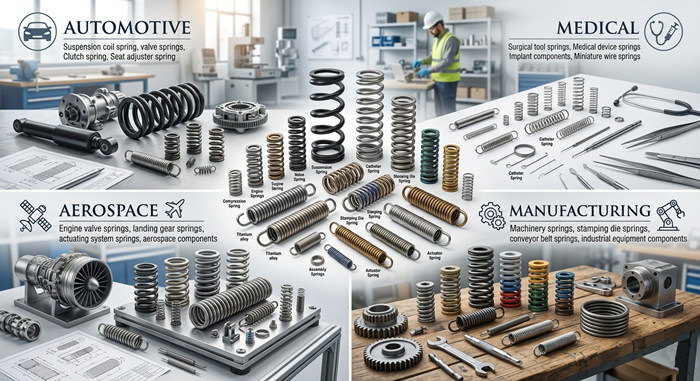
Compression springs are the most widely used type of spring and are primarily designed to withstand axial compressive loads. They are extensively used in automotive suspension systems, industrial equipment, medical devices, household appliances, and electronic products.
Key Tolerance Control Parameters
Wire Diameter
Outside Diameter / Inside Diameter (OD/ID)
Free Length
Working Height
Spring Load
Spring Rate
Squareness
Typical Applications
Automotive shock absorber springs
Die springs
Valve springs
Battery compartment springs
Common Standards
DIN 2095
EN 15800
JIS B2704
SMI Standards
In the automotive and aerospace industries, load tolerances are typically required to be controlled within ±5%, while high-precision products may require tolerances as tight as ±3%.
2. Extension Springs
Extension springs operate under tensile force and are typically designed with hooks, loops, or other specialized end configurations for attachment.
Key Tolerance Control Parameters
Free Length
Initial Tension
Extension Load
Coil Diameter
Hook/Loop Dimensions
Hook/Loop Position Deviation
Typical Applications
Automotive seat mechanisms
Agricultural machinery
Fitness equipment
Industrial door locking systems
Special Requirements
Initial tension is a critical quality characteristic of extension springs. Even when dimensional specifications are met, excessive variation in initial tension can significantly affect product performance. Therefore, it is usually inspected separately.
3. Torsion Springs
Torsion springs generate torque through angular deflection and are essential components in mechanical return and positioning systems.
Key Tolerance Control Parameters
Torque
Angular Deflection
Leg Length
Leg Position
Coil Diameter and Wire Diameter
Typical Applications
Automotive door lock mechanisms
Hinge systems
Power tools
Medical devices
Special Requirements
For automation equipment and automotive components, deviations in leg position are often more critical than dimensional deviations because they directly affect assembly accuracy.
4. Precision Miniature Springs
With the rapid growth of consumer electronics and medical devices, miniature springs have become one of the fastest-growing product categories.
Typical Products
Pogo Pin Springs
Contact Springs
Switch Springs
Springs for Minimally Invasive Medical Devices
Key Control Parameters
Micro-dimensional tolerances
Load consistency
Surface roughness
Coating thickness
Precision Levels
Some high-end products can achieve dimensional tolerances within ±0.01 mm.
5. Comparison of Tolerance Requirements Across Industries
| Industry | Dimensional Tolerance Requirement | Load Tolerance Requirement | Key Focus Areas |
| Automotive | High | High | Safety, service life |
| Medical | Very High | Very High | Stability, biocompatibility |
| Aerospace | Very High | Very High | Reliability, fatigue life |
| Consumer Electronics | High | High | Miniaturization, consistency |
| Industrial Equipment | Medium | Medium | Balance between cost and performance |
| Household Appliances | Medium | Medium | Mass-production stability |
6. Supplier Quality Control Recommendations
During spring sourcing and supplier management, it is recommended to focus on the following quality indicators:
Dimensional CPK ≥ 1.33;
Load CPK ≥ 1.33;
Perform 100% inspection on critical characteristics;
Conduct regular fatigue life testing;
Implement SPC (Statistical Process Control);
Define tolerance grades based on product application requirements;
Prioritize acceptance according to DIN, EN, JIS, or customer-specific standards.
Spring tolerance standards not only determine whether a product can be assembled successfully but also directly affect product lifespan, reliability, and end-user experience. Therefore, establishing unified tolerance specifications and inspection standards is a fundamental requirement for achieving high-quality manufacturing and effective supply chain management.