



Material Selection for Heavy-Duty Springs: A Complete Guide for Industrial Applications
Material Selection for Heavy-Duty Springs
Material selection is one of the most important factors in the design and manufacturing of heavy-duty springs. The performance, durability, fatigue life, and load capacity of a spring depend heavily on the material used.
In demanding industries such as railway, mining, construction, energy, and heavy transportation, choosing the correct spring material can significantly improve reliability and reduce maintenance costs.
This guide explains the most common materials used for heavy-duty springs and how to select the right one for your application.
Why Material Selection Matters
Heavy-duty springs operate under high loads, repeated stress cycles, and often harsh environmental conditions.
The right material helps ensure:
High load capacity
Long fatigue life
Resistance to deformation
Corrosion protection
Reliable performance
Reduced maintenance costs
Poor material selection can lead to premature failure, excessive wear, and increased downtime.
Key Factors When Selecting Spring Materials
Before choosing a material, engineers typically evaluate:
Load Requirements
The spring must withstand the required working load without permanent deformation.
Fatigue Life
Many industrial springs experience millions of compression cycles during service.
Operating Environment
Factors include:
Moisture
Salt exposure
Chemicals
High temperatures
Outdoor conditions
Cost Considerations
Higher-performance alloys generally cost more but may provide a lower total lifecycle cost.
Common Materials for Heavy-Duty Springs
1. High-Carbon Spring Steel
High-carbon steel is one of the most widely used spring materials.
Advantages
Cost-effective
Good strength
Easy processing
Widely available
Applications
General industrial springs
Agricultural machinery
Standard compression springs
Limitations
Limited corrosion resistance
Lower heat resistance compared to alloy steels
2. Chrome Silicon Steel (CrSi)
Chrome silicon steel is commonly used for high-stress applications.
Advantages
Excellent fatigue resistance
High tensile strength
Good heat resistance
Long service life
Applications
Railway suspension springs
Racing vehicle springs
Heavy machinery springs
Mining equipment
Why It Is Popular
Chrome silicon steel is often considered one of the best materials for large compression springs subjected to continuous heavy loads.
3. Chrome Vanadium Steel (CrV)
Chrome vanadium steel combines strength and toughness.
Advantages
Excellent shock resistance
High fatigue performance
Good durability
Suitable for dynamic loads
Applications
Truck suspension systems
Construction equipment
Industrial machinery
Industry Preference
Many automotive and heavy-equipment manufacturers use chrome vanadium springs because of their excellent balance between strength and durability.
4. Stainless Steel
Stainless steel is chosen when corrosion resistance is critical.
Advantages
Excellent corrosion resistance
Attractive appearance
Suitable for humid environments
Good reliability
Applications
Marine equipment
Food processing machinery
Medical equipment
Outdoor applications
Limitations
Higher cost
Lower strength than some alloy spring steels
5. Alloy Spring Steel
Various alloy steels are engineered for specialized industrial requirements.
Advantages
High strength
Excellent fatigue resistance
Superior wear resistance
Customizable properties
Applications
Mining machinery
Energy industry equipment
Heavy industrial systems
Benefits
Alloy steels are often selected when standard materials cannot meet performance requirements.
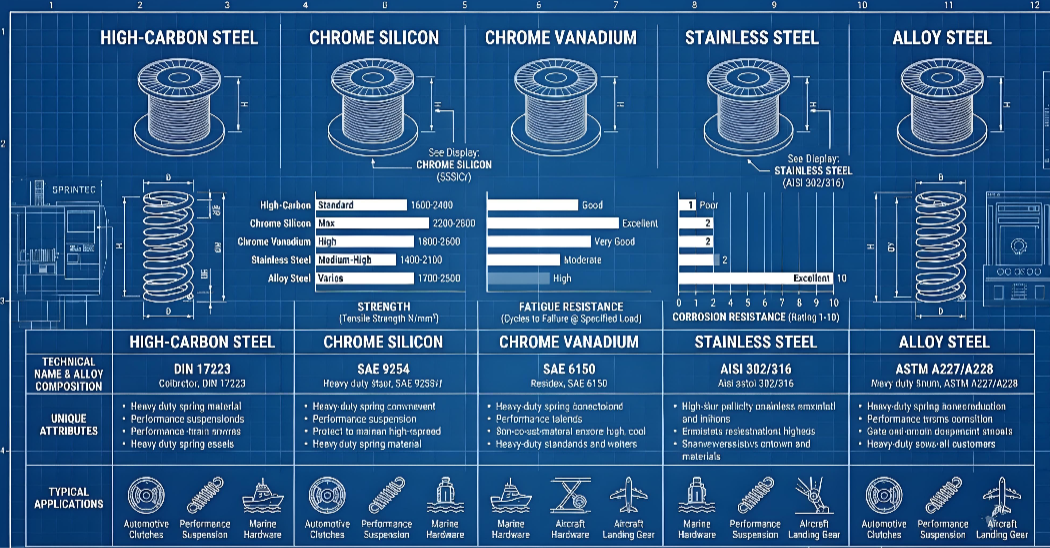
Material Comparison Table
| Material | Strength | Fatigue Resistance | Corrosion Resistance | Typical Applications |
|---|---|---|---|---|
| High-Carbon Steel | Good | Good | Low | General Industry |
| Chrome Silicon | Excellent | Excellent | Moderate | Railway, Mining |
| Chrome Vanadium | Excellent | Excellent | Moderate | Automotive, Construction |
| Stainless Steel | Good | Good | Excellent | Marine, Medical |
| Alloy Steel | Excellent | Excellent | Varies | Heavy Industry |
Choosing Materials by Industry
Railway Industry
Recommended materials:
Chrome silicon steel
Alloy spring steel
Reason:
High load requirements and long fatigue life.
Mining Industry
Recommended materials:
Chrome silicon steel
Heavy-duty alloy steel
Reason:
Extreme loads and harsh working environments.
Construction Machinery
Recommended materials:
Chrome vanadium steel
Alloy steel
Reason:
Frequent impact and vibration loads.
Agricultural Equipment
Recommended materials:
High-carbon spring steel
Chrome vanadium steel
Reason:
Balance between performance and cost.
Marine Applications
Recommended materials:
Stainless steel
Reason:
Superior corrosion resistance.
Heat Treatment and Material Performance
Even the best spring material requires proper heat treatment.
Common processes include:
Stress Relieving
Reduces residual forming stresses.
Quenching
Increases hardness and strength.
Tempering
Improves toughness and fatigue resistance.
Proper heat treatment is essential for maximizing spring performance.
Manufacturing Considerations
When producing heavy-duty springs, material selection must be matched with suitable manufacturing equipment.
Large compression springs often require:
Large CNC spring machines
Heavy-duty coiling systems
Precision heat treatment
Load testing equipment
For springs manufactured from large-diameter chrome silicon or alloy steel wire, machines such as the YF-CNC-86160 provide the forming power and stability required for consistent production.
Common Material Selection Mistakes
Avoid these common errors:
Choosing material based only on cost
Ignoring fatigue requirements
Overlooking corrosion conditions
Using general-purpose steel for high-load applications
Failing to consider operating temperature
A slightly higher material cost can often result in significantly longer service life and lower maintenance expenses.
Conclusion
Selecting the right material is essential for producing reliable heavy-duty springs. While high-carbon steel remains a cost-effective solution for many applications, chrome silicon, chrome vanadium, stainless steel, and specialized alloy steels offer superior performance for demanding industrial environments.
By considering load requirements, fatigue life, environmental conditions, and manufacturing processes, manufacturers can choose the optimal material and ensure long-term spring performance.