

3-Wire Braided Linkage Spring Making with YF-CNC-8630 Spring Machine
3-Wire Braided Linkage Spring Manufacturing with the YF-CNC-8630 CNC Spring Machine
Product and Manufacturing Overview
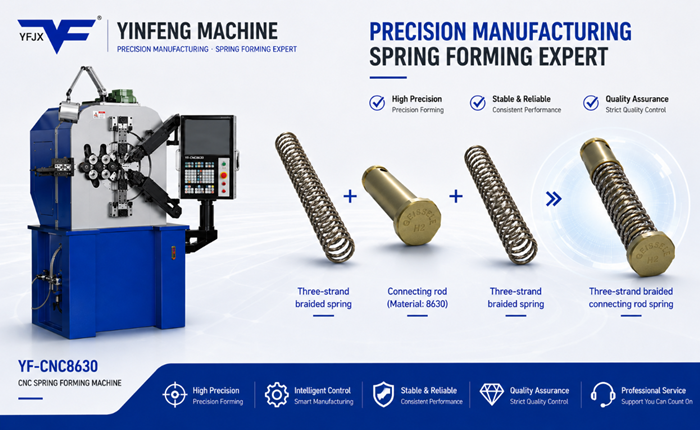
A 3-Wire Braided Linkage Spring is a special spring structure manufactured by combining three wires into one coordinated spring body.
Unlike a conventional compression spring made from a single wire, a three-wire braided spring requires the individual wires to remain correctly positioned relative to each other during feeding, coiling, pitch forming, and cutting.
This creates additional manufacturing challenges in wire synchronization, feeding stability, coil geometry, pitch consistency, and finished spring repeatability.
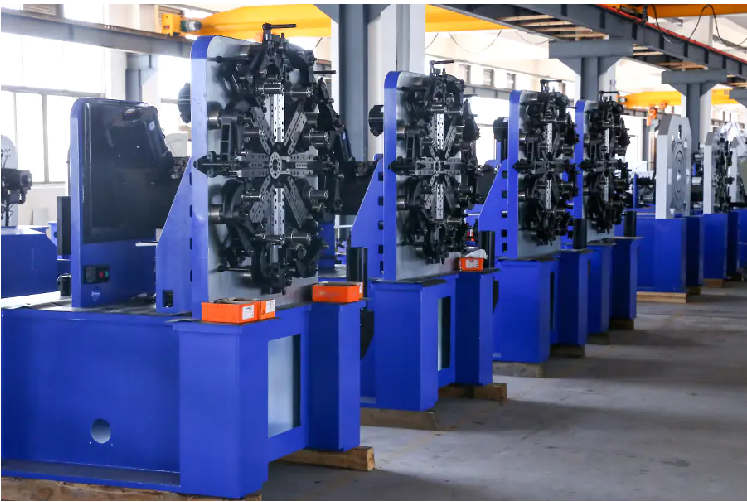
The YF-CNC-8630 CNC Compression Spring Machine can be configured for this type of specialized spring production. Through controlled wire feeding, coil diameter adjustment, pitch control, and CNC servo coordination, the machine provides a practical manufacturing solution for three-wire braided linkage springs and other customized multi-wire spring products.
What Is a 3-Wire Braided Linkage Spring?
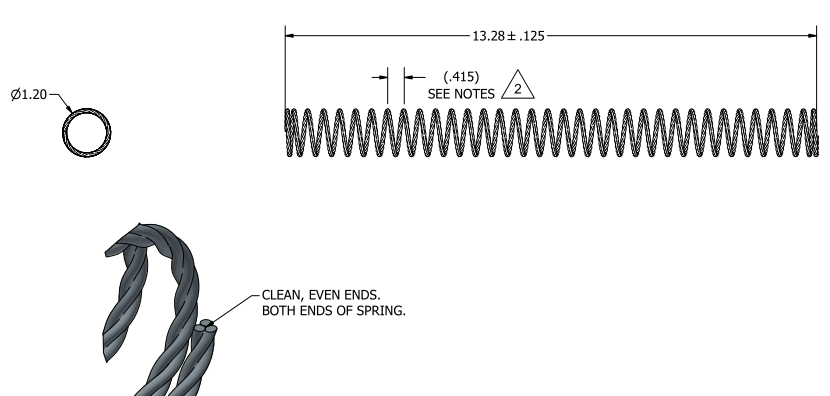
A 3-wire braided linkage spring is formed from three individual wires that are fed together and coiled into a single spring structure.
Depending on the product design, the three wires may remain parallel, partially intertwined, or positioned in a controlled multi-wire arrangement throughout the spring body.
The finished spring may contain:
Three synchronized wire strands
Cylindrical coil sections
Controlled spring pitch
Closed or open coil sections
Customized end structures
Linkage or connecting sections
Different overall spring lengths
Application-specific coil diameters
The exact structure depends on the customer's drawing, wire diameter, material, spring load requirement, and final application.
Why Use Three Wires Instead of One?
Using multiple wires can provide a different mechanical structure compared with a conventional single-wire spring.
Depending on the spring design, a three-wire construction may be selected to achieve:
Higher structural flexibility
Different load characteristics
Improved load distribution between wire strands
Special dynamic behavior
Reduced individual wire diameter compared with a single heavy wire
Application-specific damping or vibration characteristics
Unique linkage or mechanical connection requirements
The final mechanical performance should always be confirmed through engineering calculations, sample testing, and fatigue testing according to the intended application.
Main Manufacturing Challenges
Producing a three-wire braided spring is more demanding than manufacturing an ordinary single-wire compression spring.
1. Three-Wire Feeding Synchronization
All three wires must enter the forming area at a stable and controlled rate.
Uneven feeding can cause:
Strand displacement
Uneven coil geometry
Irregular pitch
Wire crossing
Spring distortion
A stable feeding and guiding system is therefore critical.
2. Wire Position Control
The relative position of the three wires must remain controlled before and during coiling.
The guide system must prevent the strands from separating, overlapping incorrectly, or changing orientation unexpectedly.
3. Coil Diameter Stability
Multi-wire construction changes the effective cross-section entering the coiling area.
The forming tools must therefore be adjusted according to:
Individual wire diameter
Combined wire arrangement
Required spring outside diameter
Material springback
Coil pitch
4. Pitch Consistency
The pitch tool must control the axial spacing of the coils while all three wires are being formed simultaneously.
Stable pitch is important for maintaining:
Overall spring length
Coil spacing
Load characteristics
Assembly compatibility
5. Cutting and End Control
Because three wires are involved, the cutting process and final end position must be evaluated according to the finished spring structure.
Special cutting or secondary finishing arrangements may be required depending on the product design.
How the YF-CNC-8630 Produces a 3-Wire Braided Linkage Spring
The production process can be divided into several controlled stages.
Step 1: Multi-Wire Preparation
Three wires with the required diameter and material specification are prepared for production.
The wires should have consistent:
Diameter
Material grade
Tensile strength
Surface condition
Straightness
Material consistency is important because differences between the three strands can affect spring geometry and forming stability.
Step 2: Wire Guiding and Alignment
The three wires enter a specially configured guiding system.
The purpose of this system is to maintain the required strand arrangement before the wires reach the feed wheels and forming area.
Correct guiding helps prevent:
Wire crossing
Strand separation
Uneven positioning
Surface damage
Step 3: Synchronized Wire Feeding
The YF-CNC-8630 feeding system moves the three wires forward as one controlled material group.
Accurate feeding determines:
Spring wire length
Number of coils
Overall spring length
Repeatability between parts
Step 4: Coil Diameter Forming
The wires enter the coiling area and are formed around the designated spring diameter.
The coiling tools are adjusted according to the combined three-wire structure rather than a conventional single wire.
During this stage, the machine must maintain consistent contact and forming pressure to keep the three strands properly positioned.
Step 5: Pitch Forming
The pitch axis controls the spacing between spring coils.
Depending on the required spring design, the machine can form:
Close-coiled sections
Open-pitch sections
Constant pitch
Variable pitch
Customized pitch transitions
Step 6: End Forming
The final spring end is produced according to the customer's required structure.
Possible configurations may include:
Open ends
Closed ends
Special linkage ends
Customized connecting structures
Actual end-forming capability depends on tooling design and product geometry.
Step 7: Cutting and Discharge
After the required number of coils and spring length are completed, the spring is cut and discharged.
The finished part can then proceed to additional processes such as:
Heat treatment
Stress relief
Surface treatment
Grinding
Load testing
Dimensional inspection
The required post-processing depends on the spring material and final application.
Why Use the YF-CNC-8630 for This Application?
The YF-CNC-8630 provides several important characteristics for customized multi-wire spring production.
6-Axis CNC Control
Independent servo-controlled movements allow the production parameters to be programmed and adjusted according to the spring design.
This helps control:
Wire feeding
Coil diameter
Pitch
Forming sequence
Cutting position
Stable Wire Feeding
Stable material feeding is especially important when three wires are processed simultaneously.
Consistent feeding helps maintain:
Strand alignment
Coil count
Spring length
Product repeatability
Programmable Spring Geometry
Operators can adjust forming parameters through the CNC control system according to different product designs.
This makes the machine suitable for:
Product development
Sampling
Small-batch production
Repeat production
Customized spring manufacturing
Program Storage and Reuse
Once the forming parameters for a specific braided linkage spring have been optimized, the production program can be stored and recalled for future orders.
This helps reduce setup time for repeat production.
YF-CNC-8630 Machine Positioning
The YF-CNC-8630 is a 6-axis CNC compression spring machine designed for precision spring manufacturing.
Standard machine characteristics include:
6-axis CNC spring forming system
Wire diameter range: Ø1.0–3.0 mm
Maximum spring outside diameter: 50 mm
CNC servo-controlled wire feeding
Programmable coil diameter
Programmable pitch control
Automatic cutting
Program storage and reuse
English control interface
Customized control-system language service
For 3-wire braided spring production, the individual wire diameter, total combined cross-section, strand arrangement, material strength, and finished spring geometry must be evaluated before final machine and tooling configuration.
Important Note About Wire Diameter
The standard YF-CNC-8630 wire processing range refers to conventional spring-wire production.
For a three-wire braided spring, the machine should not be selected simply by adding the diameters of the three individual wires.
The actual forming load depends on:
Individual wire diameter
Number of strands
Wire material
Tensile strength
Coil diameter
Spring index
Pitch
Strand arrangement
Tooling design
Customers should provide actual spring drawings and material specifications so the forming process can be evaluated correctly.
Suitable Materials
Depending on the spring design and required performance, possible materials include:
Carbon Spring Steel Wire
High-Carbon Spring Steel
Stainless Spring Steel Wire
Music Wire
Alloy Spring Steel Wire
Oil-Tempered Spring Wire
Other Suitable Spring Materials
The material selection should be based on the required:
Spring load
Fatigue life
Working temperature
Corrosion resistance
Surface requirements
Service environment
Typical Applications of 3-Wire Braided Linkage Springs
Multi-wire braided linkage springs can be used in applications where conventional single-wire springs do not provide the required structural or dynamic characteristics.
Potential applications include:
Mechanical Linkage Systems
Industrial Equipment
Vibration-Control Components
Heavy Mechanical Assemblies
Special Connection Mechanisms
Transportation Equipment
Defense and Specialized Industrial Equipment
Custom Machinery
High-Cycle Mechanical Systems
Special Engineering Spring Applications
The final application depends on the spring's mechanical design, material, load requirement, and fatigue specification.
Single-Wire Spring vs. 3-Wire Braided Spring
A conventional compression spring is normally manufactured from one continuous wire.
A 3-wire braided spring uses three coordinated strands.
The main manufacturing differences include:
Single-Wire Spring
One wire feeding path
Simpler wire guiding
Conventional coiling process
Standard spring tooling
Easier setup
3-Wire Braided Spring
Three synchronized wire paths
Specialized guiding requirements
More demanding strand positioning
More complex tooling adjustment
Greater attention to coil consistency
Additional process-development requirements
For this reason, multi-wire spring production should be treated as a customized manufacturing process rather than simply a standard compression spring operation.
Quality Control for Multi-Wire Braided Springs
Quality inspection should cover both conventional spring dimensions and multi-wire-specific features.
Recommended inspection items include:
Individual wire diameter
Material specification
Strand arrangement
Spring outside diameter
Spring inside diameter
Number of active coils
Overall spring length
Coil pitch
End position
Strand alignment
Surface condition
Spring load
Spring rate
Permanent deformation
Fatigue life where required
For linkage springs used in critical mechanical applications, functional testing under actual or simulated working conditions is recommended.
Custom Tooling for 3-Wire Spring Manufacturing
A three-wire spring usually requires customized wire guides and forming tools.
Yinfeng can evaluate the tooling configuration according to:
Individual wire diameter
Wire material
Three-wire arrangement
Finished coil diameter
Spring length
Coil pitch
End design
Production speed
Dimensional tolerance
Correct tooling design is one of the most important factors for stable multi-wire production.
Sample Testing Before Production
For special products such as a 3-wire braided linkage spring, sample testing is recommended before final production.
Customers can provide:
2D drawings
3D drawings
Physical samples
Wire diameter
Material grade
Tensile strength
Required spring load
Required dimensions
Annual production quantity
Yinfeng can use this information to evaluate:
Machine suitability
Wire feeding configuration
Tooling design
Forming sequence
Production feasibility
Sample quality
Who Is This Solution Suitable For?
This manufacturing solution is suitable for:
Spring manufacturers
Industrial component manufacturers
Mechanical linkage suppliers
Automotive and transportation component suppliers
Equipment manufacturers
Custom spring factories
Engineering companies developing specialized spring products
It is particularly suitable for manufacturers that need to develop a non-standard multi-wire spring rather than produce only conventional single-wire compression springs.
Frequently Asked Questions
Can the YF-CNC-8630 produce a 3-wire braided linkage spring?
Yes. With an appropriate multi-wire feeding, guiding, and tooling configuration, the YF-CNC-8630 can be used to develop 3-wire braided linkage spring production. Final feasibility depends on the wire diameter, material, spring geometry, and forming load.
Is a 3-wire spring the same as a normal compression spring?
No. A three-wire spring uses multiple strands that must be fed and formed together. This requires additional control of wire alignment, guiding, coil formation, and tooling.
Can three wires with different diameters be used?
This depends on the product design. Using different wire diameters increases forming complexity and should be evaluated through engineering analysis and sample testing.
Can the machine produce variable-pitch braided springs?
Variable pitch may be programmed where the spring geometry and tooling configuration allow it. The final forming process should be tested using the actual spring design.
What information should I provide before ordering the machine?
Customers should provide the spring drawing, individual wire diameter, material grade, tensile strength, coil dimensions, spring length, pitch, end design, tolerance requirements, and expected production quantity.
Can the production program be saved?
Yes. Once the forming process has been optimized, the CNC production program can be stored and recalled for repeat orders.
Does Yinfeng provide tooling for multi-wire springs?
Yinfeng can develop customized tooling and wire-guiding solutions according to the customer's spring design and material specifications.
Can Yinfeng test my 3-wire spring before machine delivery?
Yes. Customers can provide drawings, specifications, or samples for process evaluation and sample production testing.
Why Choose Yinfeng for Special Spring Manufacturing?
Non-standard springs require more than selecting a machine based only on wire diameter.
Yinfeng evaluates the complete manufacturing process, including:
Spring structure
Wire material
Feeding method
Tooling arrangement
Servo movement
Forming sequence
Dimensional tolerance
Production efficiency
Our support can include:
Product drawing evaluation
Machine selection
Custom tooling development
Sample production
CNC programming support
Factory testing
Operator training
English control interface
Customized language service
Technical support and after-sales service
Conclusion
The 3-Wire Braided Linkage Spring is a specialized multi-wire spring product that requires more precise feeding, wire alignment, coiling, pitch control, and tooling than a conventional single-wire compression spring.
The YF-CNC-8630 CNC Compression Spring Machine, combined with a properly designed three-wire feeding and guiding system, provides a flexible manufacturing platform for this type of customized spring.
For manufacturers developing multi-wire braided springs, linkage springs, or other special spring structures, the most reliable approach is to evaluate the actual drawing, material, wire diameter, forming load, and production requirement before finalizing the machine and tooling configuration.
Yinfeng can provide product evaluation, sample testing, tooling development, machine configuration, programming support, and complete spring manufacturing solutions based on customer requirements.