



What Is Spring Rate? Understanding Spring Rate in Spring Design and Manufacturing
What Is Spring Rate?
Spring rate is one of the most important characteristics of a spring. It determines how much force is required to compress or extend a spring by a specific distance. Engineers, designers, and spring manufacturers use spring rate to ensure that a spring performs correctly in its intended application.
Whether used in automotive systems, industrial machinery, medical devices, or consumer products, understanding spring rate is essential for selecting and designing the right spring.
What Is Spring Rate?
Spring rate, also known as the spring constant, is the amount of force required to move a spring by one unit of distance.
In simple terms, it describes the stiffness of a spring.
A spring with a high spring rate is stiffer and requires more force to compress or extend. A spring with a low spring rate is softer and requires less force.
Spring rate is commonly expressed as:
N/mm (Newtons per millimeter)
N/m (Newtons per meter)
lbf/in (Pounds-force per inch)
Spring Rate Formula
Spring rate can be calculated using the following equation:
k = \frac{F}{x}
Where:
k = Spring Rate
F = Applied Force (Load)
x = Deflection (Compression or Extension)
This formula shows how much force is needed for each unit of spring movement.
Example of Spring Rate Calculation
Suppose a spring requires:
50 N of force
10 mm of compression
The spring rate is:
k = 50 ÷ 10 = 5 N/mm
This means the spring requires 5 Newtons of force for every millimeter of compression.
Relationship Between Spring Rate and Spring Load
Spring rate and spring load are closely related.
Spring load is calculated by:
For example:
Spring Rate = 8 N/mm
Compression Distance = 6 mm
Spring Load = 8 × 6 = 48 N
As the compression distance increases, the spring load increases proportionally.
Factors That Affect Spring Rate
Several design factors influence the spring rate of a compression spring.
Wire Diameter
Wire diameter has a major impact on stiffness.
Larger wire diameter = Higher spring rate
Smaller wire diameter = Lower spring rate
Mean Coil Diameter
The average diameter of the spring coils affects flexibility.
Larger coil diameter = Lower spring rate
Smaller coil diameter = Higher spring rate
Number of Active Coils
Active coils are the coils that deflect under load.
More active coils = Lower spring rate
Fewer active coils = Higher spring rate
Material Properties
The material's modulus of elasticity influences spring performance.
Common materials include:
Music wire
Stainless steel
Chrome silicon
Phosphor bronze
Types of Spring Rate
Linear Spring Rate
Most standard compression springs have a linear spring rate.
The force increases proportionally as the spring compresses.
Progressive Spring Rate
A progressive spring becomes stiffer as it compresses.
This design is often used in:
Automotive suspension systems
Shock absorbers
Performance equipment
Variable Spring Rate
Variable-rate springs provide different stiffness levels throughout their travel range.
They are designed for applications requiring changing load conditions.
Why Is Spring Rate Important?
Proper spring rate selection ensures:
Correct load performance
Improved product reliability
Longer spring life
Better safety
Reduced equipment wear
An incorrect spring rate can cause:
Excessive vibration
Premature failure
Insufficient force
Overloading of components
How Manufacturers Control Spring Rate
Modern CNC spring machines precisely control:
Wire feeding
Coil diameter
Pitch spacing
Number of active coils
These parameters directly affect the final spring rate.
Advanced CNC technology helps manufacturers produce springs with highly consistent spring rates and minimal variation between production batches.
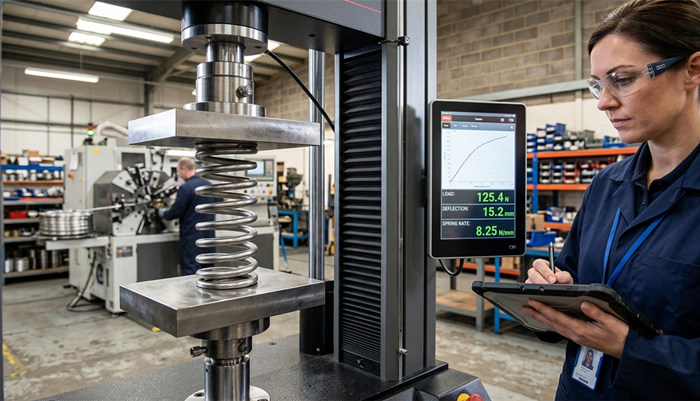
Testing Spring Rate
Spring manufacturers use spring testing machines to verify spring rate.
The process typically involves:
Applying a known load.
Measuring spring deflection.
Calculating the spring rate.
Comparing results with design specifications.
Regular testing ensures product quality and compliance with customer requirements.
Spring Rate vs Spring Pitch
Although they are related, spring rate and spring pitch are different concepts.
Spring Rate = Spring stiffness or force per unit movement.
Spring Pitch = Distance between adjacent coils.
Pitch can influence how a spring behaves during compression, while spring rate directly measures resistance to movement.
Conclusion
Spring rate is a key parameter that determines the stiffness and performance of a spring. It defines how much force is required to compress or extend the spring by a specific distance and plays a critical role in spring design and manufacturing.
By understanding spring rate, engineers and manufacturers can select the right spring for their applications, improve product performance, and ensure reliable long-term operation.