



What Springs Are Used in Cars? Types, Functions, and Applications
What Springs Are Used in Cars?
Springs are essential components in virtually every vehicle. They help absorb shocks, support vehicle weight, maintain tire contact with the road, and ensure smooth operation of many mechanical systems.
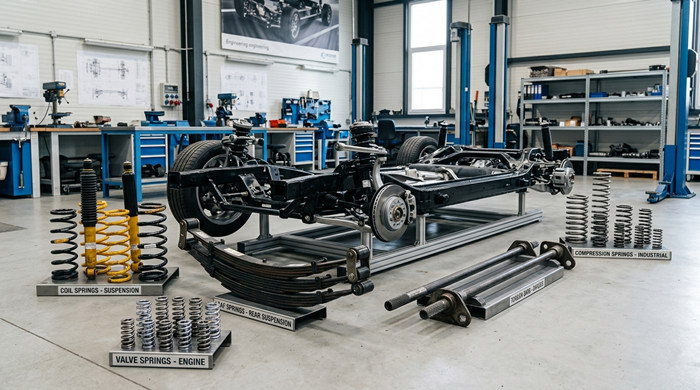
Modern cars use several different types of springs, each designed for specific functions. From suspension systems to engine components and interior mechanisms, springs play a vital role in vehicle performance, comfort, and safety.
Why Are Springs Important in Cars?
Automotive springs serve multiple purposes, including:
Supporting vehicle weight
Absorbing road impacts
Reducing vibration
Improving ride comfort
Enhancing vehicle stability
Controlling mechanical movement
Returning components to their original position
Without properly designed springs, vehicle handling, safety, and durability would be significantly reduced.
1. Coil Springs
Coil springs are the most common type of spring used in modern passenger vehicles.
Functions
Support vehicle weight
Absorb road shocks
Maintain ride height
Improve handling and comfort
Applications
Front suspension systems
Rear suspension systems
Strut assemblies
Advantages
Compact design
Excellent ride comfort
Consistent performance
Easy integration with modern suspension systems
Most sedans, SUVs, and crossover vehicles rely heavily on coil springs.
2. Leaf Springs
Leaf springs consist of multiple layers of steel strips stacked together.
Functions
Carry heavy loads
Absorb impacts
Support axle assemblies
Applications
Pickup trucks
Commercial vehicles
Heavy-duty trailers
Some off-road vehicles
Advantages
High load-carrying capacity
Durable construction
Cost-effective design
Although less common in passenger cars, leaf springs remain widely used in heavy-duty vehicles.
3. Torsion Springs (Torsion Bars)
Torsion springs store energy through twisting rather than compression.
Functions
Provide suspension support
Absorb shocks
Maintain vehicle height
Applications
Certain trucks
SUVs
Military vehicles
Specialized suspension systems
Advantages
Adjustable ride height
Compact installation
Durable operation
Some manufacturers use torsion bar suspension systems instead of traditional coil springs.
4. Valve Springs
Valve springs are located inside the engine cylinder head.
Functions
Close engine valves after opening
Maintain proper valve timing
Prevent valve float at high RPM
Applications
Intake valves
Exhaust valves
Advantages
High-speed operation
Reliable engine performance
Long service life
Valve springs are critical to engine efficiency and performance.
5. Extension Springs
Extension springs work by stretching and returning to their original length.
Functions
Provide return force
Assist mechanical movement
Applications
Brake systems
Door mechanisms
Seat adjustment systems
Throttle linkages
Advantages
Simple design
Reliable operation
Compact size
6. Compression Springs
Compression springs resist forces that push them together.
Functions
Absorb impact energy
Store mechanical energy
Provide controlled movement
Applications
Shock absorbers
Seats
Door locks
Fuel system components
Compression springs are among the most widely used spring types throughout a vehicle.
7. Clock Springs
Clock springs are specialized flat spiral springs.
Functions
Maintain electrical connections while the steering wheel rotates
Applications
Airbag systems
Steering wheel controls
Horn circuits
These springs are essential for modern steering wheel electronics.
Automotive Suspension Springs Comparison
| Spring Type | Main Function | Common Vehicle Application |
|---|---|---|
| Coil Spring | Shock absorption and support | Passenger cars, SUVs |
| Leaf Spring | Heavy load support | Trucks, trailers |
| Torsion Spring | Suspension support | Trucks, SUVs |
| Compression Spring | Energy absorption | Various vehicle systems |
| Extension Spring | Return force | Brakes, seats, controls |
| Valve Spring | Valve operation | Engines |
| Clock Spring | Electrical connection | Steering systems |
How Automotive Springs Are Manufactured
Modern automotive springs are produced using advanced CNC spring machines and automated heat treatment systems.
The manufacturing process typically includes:
Wire feeding
Spring coiling
Heat treatment
Grinding (if required)
Surface treatment
Load testing
Quality inspection
CNC spring machines ensure high precision, repeatability, and consistent spring performance for automotive applications.
Choosing the Right Spring for Automotive Applications
Engineers consider several factors when selecting automotive springs:
Load requirements
Available installation space
Vehicle weight
Durability requirements
Operating environment
Fatigue life expectations
Proper spring selection is critical for vehicle safety, comfort, and reliability.
Conclusion
Cars use a wide variety of springs, each serving a unique purpose. Coil springs, leaf springs, torsion springs, valve springs, extension springs, and compression springs all contribute to vehicle performance and safety.
As automotive technology continues to evolve, modern CNC spring manufacturing enables the production of highly precise and durable springs that meet the demanding requirements of today's vehicles.