
How Many Axes Do I Need? Choosing the Right CNC Spring Machine
How Many Axes Do I Need?
One of the most common questions when purchasing a CNC spring machine is: "How many axes do I need?"
The answer depends on the types of springs you produce, the complexity of your products, and your future production requirements. While machines with more axes offer greater flexibility and forming capabilities, they also come with higher costs and increased programming complexity.
Understanding what each axis does can help you choose the right machine for your business.
What Does an Axis Mean in a CNC Spring Machine?
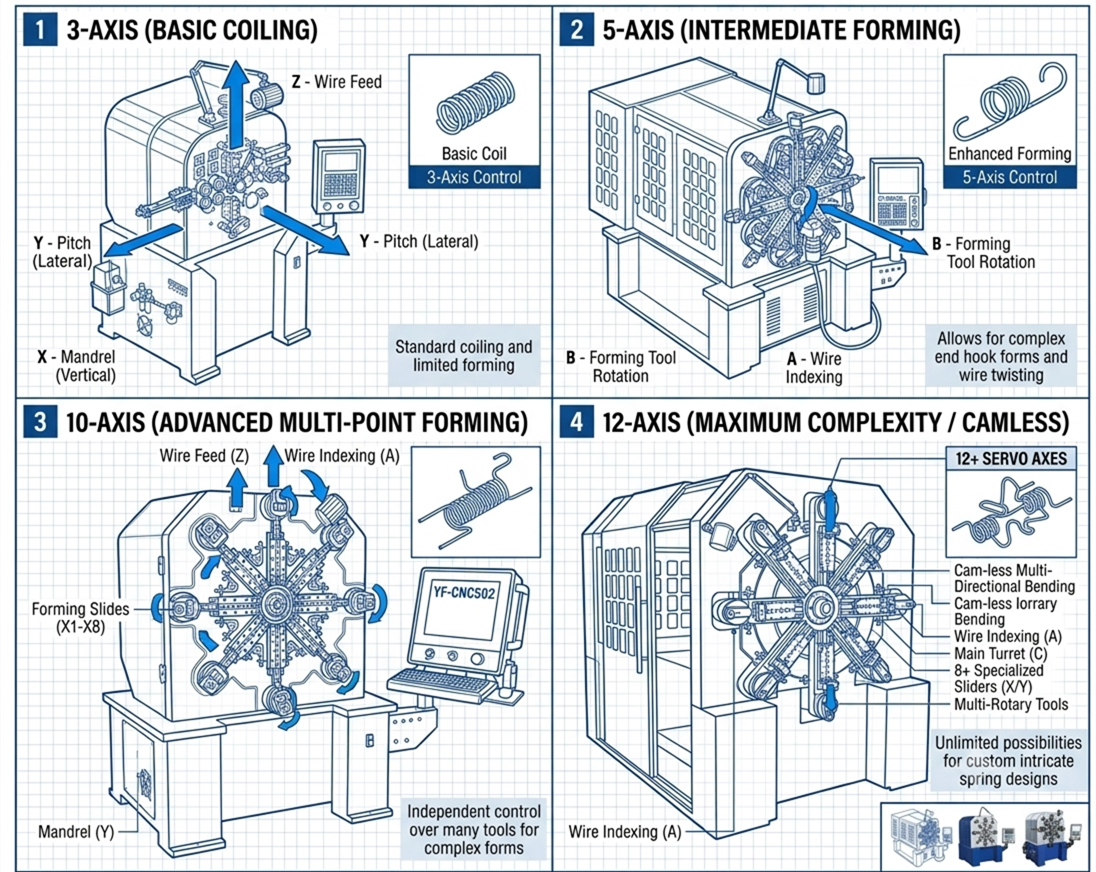
In a CNC spring machine, an axis refers to a servo-controlled movement that performs a specific manufacturing function.
Common functions controlled by axes include:
Wire feeding
Coiling
Pitch control
Wire rotation
Tool positioning
Forming arm movement
Cutter operation
The more axes a machine has, the more complex spring shapes it can produce.
2-Axis CNC Spring Machines
A 2-axis machine is typically the entry-level option.
Capabilities
Basic compression springs
Simple coil springs
Standard spring geometries
Advantages
Lower investment cost
Easier operation
Faster setup for simple products
Best For
Standard compression spring production
High-volume manufacturing of simple springs
Small spring factories
5-Axis CNC Spring Machines
5-axis spring machines are among the most popular configurations.
Capabilities
Compression springs
Extension springs
Torsion springs
Variable pitch springs
Advantages
Increased flexibility
Better precision
Faster changeovers
Best For
Automotive springs
Electronics industry springs
General industrial spring production
For many manufacturers, a 5-axis machine provides an excellent balance between capability and cost.
8-Axis CNC Spring Machines
8-axis machines offer advanced forming capabilities.
Capabilities
Complex spring geometries
Multi-bend wire forms
Precision custom springs
Advantages
Greater design freedom
Reduced secondary operations
Improved production efficiency
Best For
Custom spring manufacturers
Medical device components
Aerospace applications
High-value precision parts
10-Axis and Multi-Axis Machines
Advanced wire forming machines may feature 10, 12, or even more servo axes.
Capabilities
Complex 3D wire forms
Multi-directional bending
Integrated forming operations
Advantages
Maximum flexibility
Highly automated production
Ability to manufacture challenging designs
Best For
Complex wire forms
Automotive seat frames
Medical wire products
Specialty industrial components
How Product Complexity Affects Axis Requirements
Simple Compression Springs
Recommended:
2 to 5 axes
Compression and Torsion Springs
Recommended:
5 to 10axes
Custom-Shaped Springs
Recommended:
10+ axes
Complex Wire Forms
Recommended:
12+ axes
The more bends, hooks, loops, and forming operations required, the more axes are typically needed.
Cost vs Capability
| Machine Type | Typical Axes | Complexity Level |
|---|---|---|
| Basic Spring Machine | 2-3 Axes | Low |
| Standard CNC Spring Machine | 5 Axes | Medium |
| Advanced Spring Machine | 12 Axes | High |
| Wire Forming Machine | 12+ Axes | Very High |
Although machines with more axes cost more initially, they can significantly reduce labor costs, tooling changes, and secondary processing.
Future-Proofing Your Investment
When selecting a machine, consider not only your current products but also future opportunities.
Questions to ask include:
Will I produce more complex springs in the future?
Do I plan to enter automotive or medical markets?
Will customer requirements become more demanding?
Do I need faster product changeovers?
Purchasing a machine with slightly more capability than currently required often provides better long-term value.
Conclusion
The number of axes you need depends on the complexity of your products and your production goals.
2–3 axes are suitable for basic compression springs.
5 axes are ideal for most general spring manufacturing.
10 axes are recommended for complex spring designs.
12+ axes are best for advanced wire forms and highly customized products.
By matching machine capability to your manufacturing requirements, you can maximize productivity, improve product quality, and achieve a stronger return on investment.