Can One Machine Produce Different Springs? A Guide to CNC Spring Machine Flexibility
Can One Machine Produce Different Springs?
One of the most common questions from spring manufacturers is whether a single machine can produce different types of springs. The answer is yes—modern CNC spring machines are designed to manufacture a wide variety of spring types and wire forms with minimal setup changes.
Unlike traditional spring machines that often require extensive mechanical adjustments, CNC spring machines use programmable controls and servo-driven systems, allowing manufacturers to switch quickly between different spring designs.
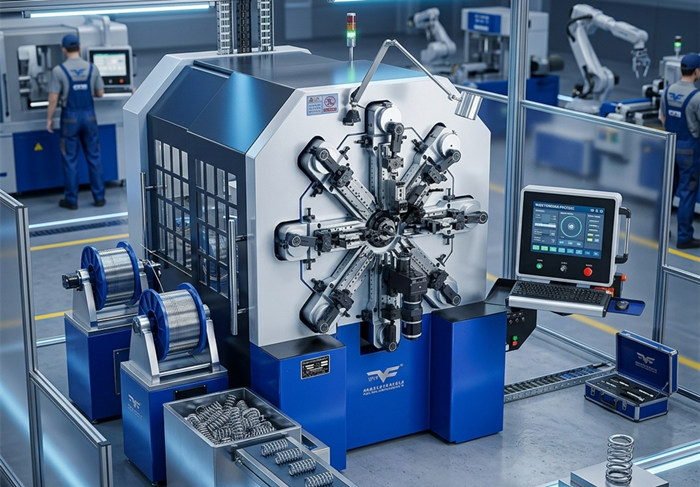
The Evolution of Spring Manufacturing
Traditional spring machines were typically optimized for producing one specific spring type. Changing to another spring design often required:
Replacing cams
Adjusting tooling
Lengthy machine setup
Extensive operator intervention
Modern CNC spring machines eliminate many of these limitations through software-controlled production.
What Types of Springs Can One CNC Spring Machine Produce?
Depending on the machine configuration and number of axes, a single CNC spring machine can manufacture multiple spring types.
Compression Springs
Compression springs are the most common spring type.
Applications include:
Automotive suspension components
Industrial equipment
Consumer products
Medical devices
CNC spring machines can easily adjust:
Coil diameter
Wire diameter
Pitch
Number of coils
to create different compression spring designs.
Extension Springs
Extension springs are designed to work under tension.
Typical applications include:
Garage doors
Agricultural equipment
Industrial machinery
Fitness equipment
By modifying end-hook configurations and spring dimensions, the same machine can produce a wide range of extension springs.
Torsion Springs
Torsion springs store energy through rotational force.
Applications include:
Door hinges
Automotive components
Electrical switches
Industrial assemblies
Modern CNC machines can accurately form torsion legs, bends, and angles without requiring separate production equipment.
Double Torsion Springs
Double torsion springs are commonly used in:
Automotive mechanisms
Seat systems
Industrial controls
Many advanced CNC spring machines can produce these springs with dedicated forming tools and programmable operations.
Wire Forms
Beyond springs, many CNC spring machines can manufacture custom wire forms.
Examples include:
Clips
Hooks
Retainers
Brackets
Custom wire components
This significantly expands the machine's production capabilities.
How Can One Machine Produce Different Springs?
The flexibility comes from several key technologies.
CNC Programming
Operators can save multiple production programs and quickly switch between products.
Instead of changing mechanical cams, operators simply load a new production program.
Servo Motor Control
Servo-driven axes precisely control:
Wire feed
Coiling
Pitch
Cutting
Bending
This enables rapid adjustment for different spring designs.
Quick Tool Changes
Modern machines are designed with tooling systems that reduce changeover time.
Many manufacturers can switch from one product to another in a matter of minutes.
Multi-Axis Forming
Machines with additional axes can handle more complex spring geometries and wire forms without requiring secondary operations.
Benefits of Producing Different Springs on One Machine
Increased Flexibility
Manufacturers can respond quickly to customer requirements and produce a wider range of products.
Reduced Equipment Investment
Instead of purchasing multiple dedicated machines, one CNC machine can perform several production tasks.
Faster Changeovers
Digital programming significantly reduces setup time.
Improved Productivity
Operators spend less time on mechanical adjustments and more time producing parts.
Lower Inventory Requirements
A single machine can accommodate small-batch and custom orders efficiently.
Factors That Determine Production Capability
Not every CNC spring machine can produce every type of spring.
Key factors include:
Number of Axes
More axes generally provide greater forming flexibility.
Wire Diameter Range
Machines are designed for specific wire diameter capacities.
Tooling Configuration
Some spring types require specialized tooling.
Machine Software
Advanced control systems support more complex spring geometries.
When Multiple Machines May Be Needed
Although one machine can produce many spring types, certain situations may still require specialized equipment:
Very large wire diameters
Ultra-high production volumes
Specialized valve spring production
Heavy-duty suspension springs
Highly complex 3D wire forms
In these cases, dedicated machines may provide better efficiency.
Conclusion
Modern CNC spring machines are highly versatile and capable of producing multiple types of springs, including compression springs, extension springs, torsion springs, double torsion springs, and custom wire forms.
By utilizing CNC programming, servo control, and multi-axis technology, manufacturers can switch quickly between products, reduce setup time, and maximize production efficiency. For many businesses, a single CNC spring machine can handle a broad range of production requirements while reducing equipment costs and increasing operational flexibility.