



2D vs 3D Wire Bending Machine: Which Is Better?
2D vs 3D Wire Bending Machine: Which Is Better?
Wire bending machines are widely used to manufacture hooks, clips, brackets, retainers, and various custom wire products. Depending on product complexity, manufacturers usually choose between 2D wire bending machines and 3D wire bending machines.
But which one is better?
The answer depends on the shapes you need to produce, production requirements, and future expansion plans. Understanding the differences between these two types of machines can help you make the right investment.
What Is a 2D Wire Bending Machine?
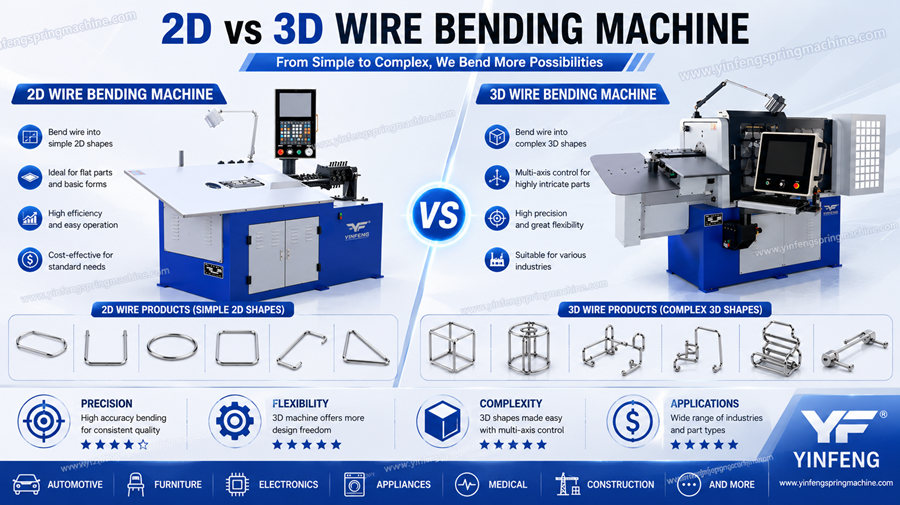
A 2D wire bending machine is designed to produce wire products that lie mainly on a single plane.
The machine performs operations such as:
Wire feeding
Straightening
Bending
Cutting
Since all bends are made in one plane, 2D machines are suitable for relatively simple shapes.
Typical Products Made by 2D Machines
Hooks
U-shaped parts
Flat brackets
Handles
Rings
Simple clips
These products do not require rotation or three-dimensional forming.
What Is a 3D Wire Bending Machine?
A 3D wire bending machine combines traditional bending functions with rotational capabilities, allowing the machine to create complex three-dimensional wire products.
Besides feeding and bending, the machine can:
Rotate the wire
Perform multi-angle bending
Produce complex spatial geometries
Create customized wire forms
3D wire bending machines offer significantly greater flexibility.
Typical Products Made by 3D Machines
Automotive retainers
Spring clips
Display racks
Basket frames
Medical wire components
Custom wire forms
Electronic hardware parts
These products often require multiple bending directions and spatial structures.
Main Differences Between 2D and 3D Wire Bending Machines
| Feature | 2D Wire Bending Machine | 3D Wire Bending Machine |
|---|---|---|
| Forming Capability | Flat shapes | Complex 3D shapes |
| Wire Rotation | No | Yes |
| Product Complexity | Simple | Complex |
| Flexibility | Moderate | High |
| Number of Axes | Fewer | Multiple servo axes |
| Programming Difficulty | Easier | More advanced |
| Production Range | Limited | Extensive |
| Investment Cost | Lower | Higher |
Which Machine Provides More Flexibility?
3D wire bending machines are far more versatile.
With programmable multi-axis control, one machine can manufacture a wide range of products with minimal tooling changes.
Advantages include:
Complex shape capability
Faster product changeovers
High precision
Program storage and reuse
Improved production efficiency
For manufacturers serving multiple industries, 3D wire bending machines provide long-term advantages.
When Is a 2D Machine the Better Choice?
A 2D wire bending machine is ideal when:
Products are relatively simple.
Most parts are flat.
Production volume is high.
Investment budget is limited.
Product variety is small.
For basic wire products, 2D machines offer excellent efficiency and lower operating costs.
When Is a 3D Machine the Better Choice?
A 3D wire bending machine is recommended when:
Products require multiple bending directions.
Customers request customized wire shapes.
High precision is essential.
Production flexibility is important.
Future product expansion is expected.
The machine's ability to handle complex geometries makes it suitable for advanced manufacturing applications.
What Materials Can Both Machines Process?
Both 2D and 3D wire bending machines can process:
Carbon steel wire
Stainless steel wire
Spring steel wire
Copper wire
Aluminum wire
Phosphor bronze wire
Material compatibility depends mainly on wire diameter capacity and machine configuration.
Which Industries Use 2D and 3D Wire Bending Machines?
Automotive Industry
Produces clips, retainers, and support components.
Electronics Industry
Manufactures conductive wire parts and connectors.
Home Appliance Industry
Creates racks, handles, and wire frames.
Furniture Industry
Produces support structures and accessories.
Medical Industry
Manufactures precision wire components.
Hardware Industry
Produces hooks, brackets, and fastening products.
Why Choose Yinfeng Wire Bending Machines?
Yinfeng provides both 2D and 3D wire bending solutions with:
High-speed servo control systems
Stable production performance
User-friendly programming
Program storage and reuse functions
English and customized language support
Technical training and after-sales service
Flexible solutions for custom wire products
These advantages help manufacturers achieve higher efficiency and reliable production.
Which Is Better?
There is no absolute answer.
If your products are mainly flat and simple, a 2D wire bending machine may be the most economical choice.
However, if you require higher flexibility, complex geometries, and broader production capabilities, a 3D wire bending machine is the better long-term investment.
Conclusion
2D and 3D wire bending machines each have their own strengths. While 2D machines are suitable for simple wire products, 3D machines provide greater flexibility and the ability to manufacture complex components.
Choosing the right machine depends on your product requirements, production goals, and future business plans. For manufacturers seeking maximum versatility and efficiency, advanced CNC 3D wire bending machines offer significant advantages.