
How Does a CNC Wire Forming Machine Work?
How Does a CNC Wire Forming Machine Work?
CNC wire forming machines are widely used in industries such as automotive, electronics, medical devices, and hardware manufacturing. These machines use advanced servo control systems and programmable software to transform straight metal wire into precise two-dimensional and three-dimensional wire products.
Understanding how a CNC wire forming machine works can help manufacturers improve productivity, product quality, and production flexibility.
What Is a CNC Wire Forming Machine?
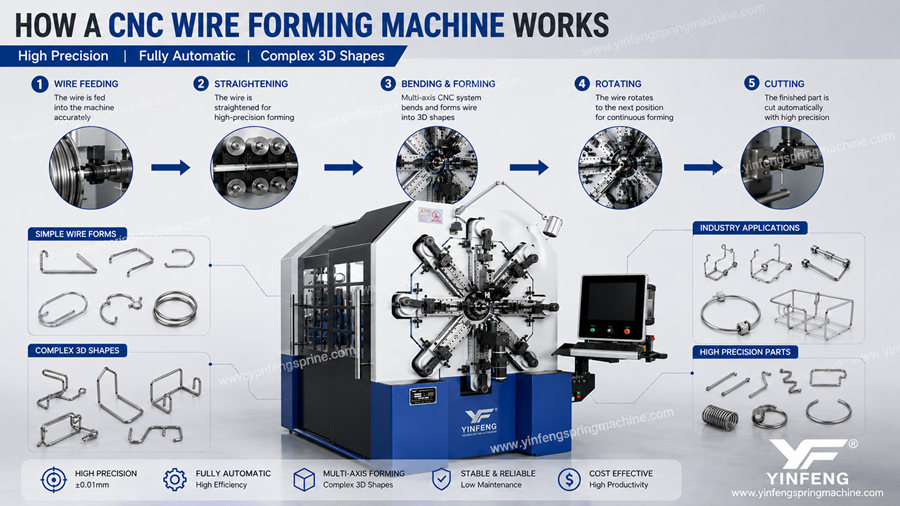
A CNC wire forming machine is an automated manufacturing system designed to feed, straighten, bend, rotate, and cut metal wire into specific shapes according to programmed instructions.
Unlike traditional manual bending equipment, CNC technology allows high-speed production with excellent repeatability and accuracy.
These machines can produce simple wire hooks as well as complex three-dimensional wire forms with minimal manual intervention.
Step 1: Wire Feeding
The process begins with wire material supplied from a wire spool.
Feed rollers driven by servo motors continuously pull the wire into the machine at a controlled speed.
Accurate wire feeding is essential because it determines:
Product length
Forming accuracy
Production consistency
Precise feeding ensures stable production and reduces material waste.
Step 2: Wire Straightening
Before entering the forming area, the wire passes through a straightening system.
The straightening unit removes the natural curvature created during wire winding and prepares the material for accurate processing.
Proper straightening improves:
Dimensional accuracy
Surface quality
Product consistency
Different wire materials and diameters may require corresponding straightening adjustments.
Step 3: Wire Bending and Forming
Once the wire reaches the forming area, multiple servo-controlled tools perform bending operations according to the programmed design.
These tools can create:
Angles
Curves
Loops
Hooks
Clips
Complex geometries
Multi-axis control enables the machine to achieve high precision and repeatability.
Step 4: Wire Rotation
Advanced CNC wire forming machines use rotating heads or wire rotation mechanisms to produce complex three-dimensional shapes.
Wire rotation allows the machine to manufacture products such as:
Spring clips
Automotive retainers
Display racks
Custom wire forms
Medical wire components
This capability significantly expands the range of products that can be produced.
Step 5: Cutting
After the forming process is completed, the cutting unit separates the finished part from the wire material.
High-speed cutters provide:
Clean cutting surfaces
Stable dimensions
High production efficiency
The completed wire product is then discharged automatically.
What Components Make Up a CNC Wire Forming Machine?
A typical CNC wire forming machine includes:
Wire Feeding System
Responsible for accurately supplying material.
Straightening Unit
Removes wire curvature before forming.
Servo Motors
Provide precise movement and positioning.
Forming Tools
Perform bending and shaping operations.
Rotating Mechanism
Creates three-dimensional wire products.
Cutting Device
Separates finished products automatically.
CNC Control System
Controls all machine movements and stores production programs.
Together, these components ensure efficient and accurate production.
What Materials Can Be Processed?
Modern CNC wire forming machines can process various materials, including:
Carbon steel wire
Stainless steel wire
Spring steel wire
Copper wire
Aluminum wire
Phosphor bronze wire
Parameter adjustments allow one machine to handle different materials and wire diameters.
What Products Can Be Manufactured?
CNC wire forming machines can produce:
Hooks
Clips
Brackets
Handles
Retainers
Display racks
Automotive components
Medical wire parts
Electrical connectors
Custom wire forms
The flexibility of CNC programming allows manufacturers to switch between products quickly.
Advantages of CNC Wire Forming Machines
High Precision
Servo control systems ensure consistent product dimensions.
High Efficiency
Automated production increases output and reduces labor requirements.
Flexible Manufacturing
Saved programs allow rapid product changeovers.
Lower Material Waste
Accurate forming improves material utilization.
Reduced Labor Costs
One operator can often manage multiple machines.
Excellent Repeatability
Identical products can be produced consistently over long production runs.
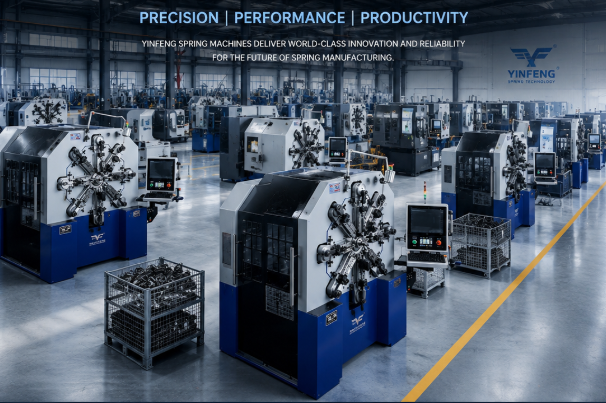
Why Choose Yinfeng CNC Wire Forming Machines?
Yinfeng wire forming machines provide:
High-speed servo control
Stable production performance
User-friendly programming
Program storage and reuse
English and customized language support
Technical training and after-sales service
Flexible solutions for various wire products
These advantages help manufacturers improve efficiency and achieve reliable production.
Conclusion
A CNC wire forming machine works by combining wire feeding, straightening, bending, rotation, and cutting into one automated process. With advanced servo control and programmable technology, these machines deliver high precision, efficiency, and flexibility for producing a wide range of wire products.
For manufacturers seeking reliable and cost-effective production, CNC wire forming machines provide an ideal solution for modern wire component manufacturing.