

Wire Forming vs Wire Bending: What's the Difference?
Wire Forming vs Wire Bending: What's the Difference?
Wire forming and wire bending are closely related manufacturing processes used to shape metal wire into functional components. Although the terms are often used interchangeably, they are not exactly the same.
Understanding the differences between wire forming and wire bending can help manufacturers choose the right process and equipment for their products.
What Is Wire Bending?
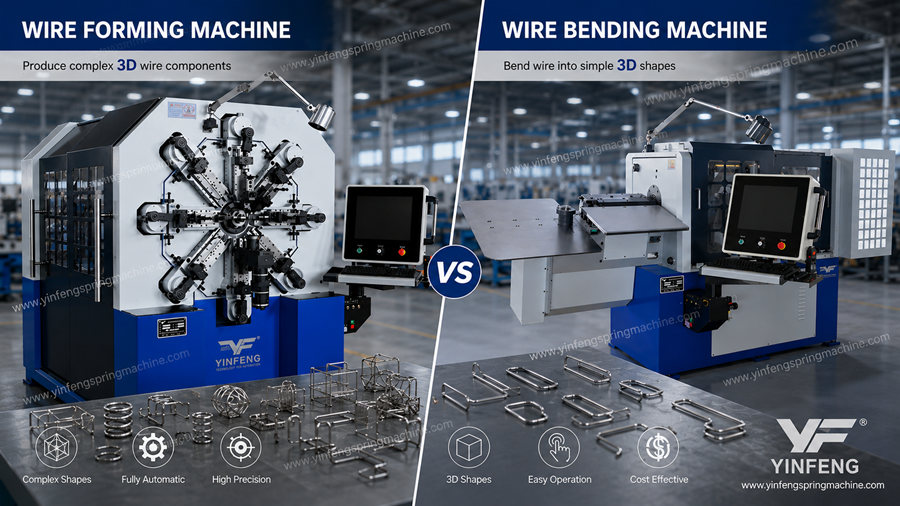
Wire bending is the process of bending metal wire into specific angles or simple geometric shapes.
The process typically involves:
Straight wire feeding
One or multiple bending operations
Simple two-dimensional or three-dimensional shapes
Manual, semi-automatic, or CNC-controlled equipment
Wire bending focuses primarily on changing the angle and direction of the wire.
Common wire bending products include:
Hooks
Rings
Handles
U-shaped parts
Simple brackets
Wire bending is usually suitable for relatively simple products with limited forming complexity.
What Is Wire Forming?
Wire forming is a broader manufacturing process that includes wire bending as one of its operations.
In addition to bending, wire forming may involve:
Feeding
Straightening
Multiple-angle bending
Rotation
Coiling
Twisting
Cutting
Complex three-dimensional forming
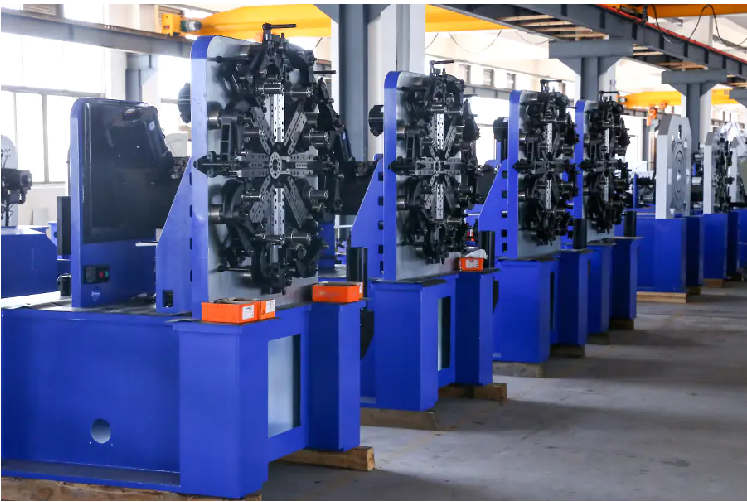
Wire forming machines can create highly customized parts with complex geometries and multiple features.
Typical wire forming products include:
Automotive clips
Retainers
Spring clips
Wire baskets
Display racks
Medical wire components
Electronic connectors
Custom wire shapes
In simple terms, wire bending is part of wire forming, but wire forming offers much greater flexibility.
Main Differences Between Wire Forming and Wire Bending
| Feature | Wire Bending | Wire Forming |
|---|---|---|
| Process Complexity | Simple | Complex |
| Number of Operations | Mainly bending | Multiple forming operations |
| Shape Capability | Basic shapes | Complex 2D and 3D shapes |
| Precision | Moderate | High |
| Automation Level | Manual or CNC | Mainly CNC |
| Product Variety | Limited | Extensive |
| Production Efficiency | Medium | High |
| Applications | Simple parts | Precision components |
Which Process Offers More Flexibility?
Wire forming provides significantly greater flexibility.
Modern CNC wire forming machines allow manufacturers to:
Produce multiple product designs.
Create complex three-dimensional wire parts.
Save and reuse programs.
Achieve excellent repeatability.
Reduce setup time.
Improve production efficiency.
Wire bending machines are generally more suitable for simple parts and basic manufacturing requirements.
What Materials Can Both Processes Handle?
Both wire forming and wire bending can process:
Carbon Steel Wire
Suitable for industrial and hardware applications.
Stainless Steel Wire
Widely used in medical, food, and automotive industries.
Spring Steel Wire
Provides excellent elasticity and fatigue resistance.
Copper Wire
Used for electrical and conductive components.
Aluminum Wire
Lightweight and corrosion-resistant.
Phosphor Bronze Wire
Commonly used in electronics and precision parts.
Material selection depends on product requirements and machine capacity.
Which Industries Use Wire Forming and Wire Bending?
Automotive Industry
Used to manufacture clips, retainers, and structural components.
Electronics Industry
Produces conductive wire components and connectors.
Medical Industry
Creates surgical and precision wire parts.
Furniture Industry
Manufactures frames and support structures.
Home Appliance Industry
Produces racks, handles, and brackets.
Hardware Industry
Creates hooks, clips, and fastening products.
Which Machine Should You Choose?
Choose a Wire Bending Machine If:
Products have simple shapes.
Production requirements are relatively basic.
Investment budget is limited.
Manual or semi-automatic operation is acceptable.
Choose a CNC Wire Forming Machine If:
Products require complex geometries.
High precision is essential.
Multiple product types are needed.
Fast changeovers are required.
Automation and efficiency are priorities.
For modern manufacturers, CNC wire forming machines provide higher flexibility and long-term productivity advantages.
Why Choose Yinfeng Wire Forming Machines?
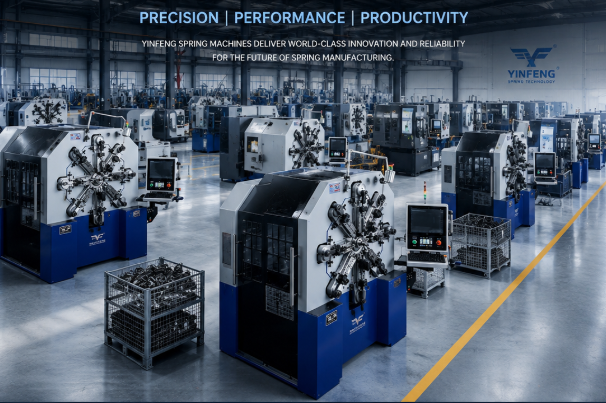
Yinfeng CNC wire forming machines offer:
High-speed servo systems
Precise multi-axis control
Excellent repeatability
User-friendly programming
Program storage and reuse
English and customized language support
Technical training and after-sales service
These features help manufacturers improve efficiency while producing high-quality wire products.
Conclusion
Wire bending and wire forming are related processes, but wire forming provides broader capabilities and greater flexibility. While wire bending is ideal for simple shapes, wire forming combines multiple operations to create complex and highly customized wire components.
For manufacturers seeking higher efficiency, precision, and versatility, CNC wire forming machines represent the most advanced solution for modern wire product manufacturing.