
Large Spring Machine Buying Guide 2026: How to Choose the Right CNC Spring Machine
Large Spring Machine Buying Guide 2026
As industries such as automotive, railway, mining, construction, and energy continue to expand, the demand for large compression springs and heavy-duty industrial springs is growing rapidly. For manufacturers planning to increase production capacity or enter new markets, investing in the right large spring machine is a critical decision.
This guide explains the most important factors to consider when purchasing a large spring machine in 2026.
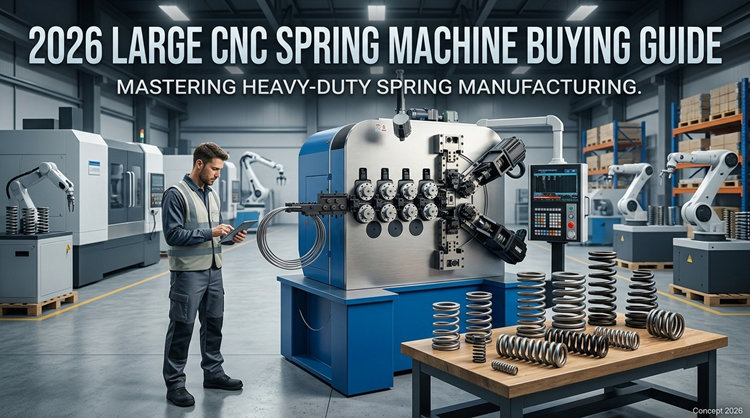
Why Choosing the Right Machine Matters
A large spring machine is a long-term investment that directly affects:
Production efficiency
Product quality
Manufacturing flexibility
Operating costs
Return on investment
Selecting equipment that matches your production requirements can help avoid unnecessary costs and future limitations.
Define Your Spring Production Requirements
Before comparing machines, clearly identify the types of springs you plan to manufacture.
Common products include:
Large Compression Springs
Used in:
Railway systems
Mining equipment
Industrial machinery
Construction equipment
Heavy-Duty Torsion Springs
Used in:
Industrial doors
Mechanical systems
Agricultural equipment
Custom Industrial Springs
Used in:
Energy equipment
Special-purpose machinery
OEM manufacturing projects
The more accurately you define your product range, the easier it becomes to select the correct machine configuration.
Evaluate Wire Diameter Capacity
Wire diameter is one of the most important purchasing factors.
Typical machine categories include:
| Wire Diameter Range | Application |
|---|---|
| 8–16 mm | Medium-duty springs |
| 12–25 mm | Large industrial springs |
| 20–40 mm | Heavy-duty compression springs |
| 40 mm+ | Specialized large spring production |
Choose a machine that supports both your current production needs and future growth plans.
Consider Maximum Spring Dimensions
Large spring machines vary significantly in their production capabilities.
Evaluate:
Maximum spring outside diameter
Maximum free length
Maximum coil diameter
Maximum spring weight
Buying a machine with limited capacity may restrict future business opportunities.
CNC vs Traditional Machines
In 2026, CNC technology has become the preferred solution for most manufacturers.
CNC Spring Machine Advantages
Higher accuracy
Faster setup
Digital program storage
Better repeatability
Lower labor requirements
Quick product changeovers
Traditional machines may still be suitable for certain high-volume standard products, but CNC machines offer greater flexibility and long-term competitiveness.
Number of Axes Matters
Machine capability often depends on the number of servo-controlled axes.
3-Axis Machines
Suitable for:
Standard compression springs
Basic spring production
4-Axis Machines
Suitable for:
Medium-complexity springs
Diverse production requirements
5-Axis and Multi-Axis Machines
Suitable for:
Complex spring geometries
Custom wire forms
Specialized industrial applications
More axes generally provide greater manufacturing flexibility.
Evaluate Automation Features
Modern spring manufacturers increasingly prioritize automation.
Important features include:
Servo-controlled feeding
Automatic pitch adjustment
Automatic cutting
Program memory storage
Real-time production monitoring
Fault diagnosis systems
Automation helps reduce labor costs and improve consistency.
Machine Structure and Stability
Large spring production generates significant forming forces.
Look for:
Heavy-duty machine frames
High-strength forming systems
Reliable servo motors
Quality bearings and guides
Stable electrical systems
A rigid machine structure improves accuracy and extends equipment life.
Recommended Machine for Large Compression Springs
For manufacturers producing heavy-duty compression springs, machines such as the YF-CNC-86160 provide an effective balance of power, precision, and flexibility.
Key advantages include:
Designed for large spring production
CNC servo control technology
Stable wire feeding and coiling
High production efficiency
Suitable for railway, mining, construction, and industrial applications
When evaluating equipment, compare machine specifications with your actual production requirements rather than focusing solely on initial purchase price.
Service and Technical Support
Reliable after-sales support is often as important as the machine itself.
Consider whether the supplier provides:
Installation assistance
Operator training
Remote technical support
Spare parts availability
Software updates
Maintenance guidance
Strong support can significantly reduce downtime and operating costs.
Total Cost of Ownership
The lowest purchase price does not always deliver the best value.
Evaluate:
Energy consumption
Labor requirements
Maintenance costs
Spare parts costs
Production efficiency
Product quality
A higher-quality machine often provides a better return on investment over its service life.
Questions to Ask Before Buying
Before making a final decision, ask:
What wire diameter range can the machine handle?
What is the maximum spring diameter and length?
How many CNC axes are included?
What production speed can be achieved?
What training and support are provided?
Are spare parts readily available?
Can the machine accommodate future product requirements?
Conclusion
Choosing a large spring machine in 2026 requires careful evaluation of production needs, machine capabilities, automation features, and long-term operating costs. A modern CNC spring machine offers the precision, flexibility, and efficiency needed to remain competitive in today's industrial market.
By selecting a machine with the right wire capacity, CNC configuration, and support services, manufacturers can improve productivity, reduce costs, and position their business for future growth.