
Tine Carrier Spring Making Machine | CNC Agricultural Tine Spring Manufacturing Solution
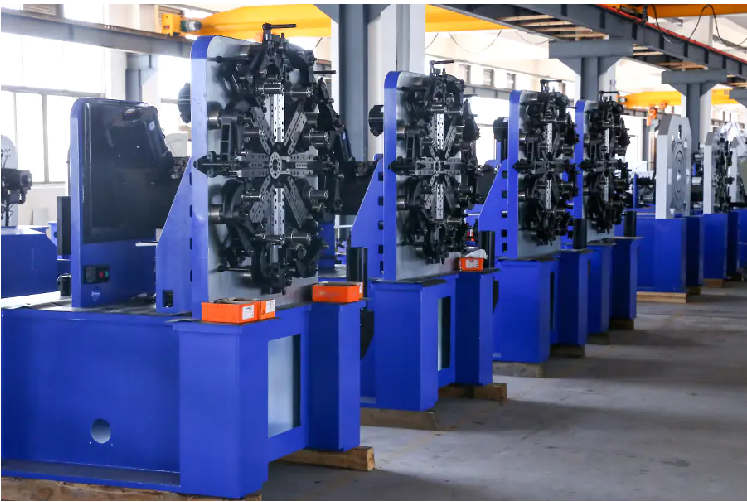
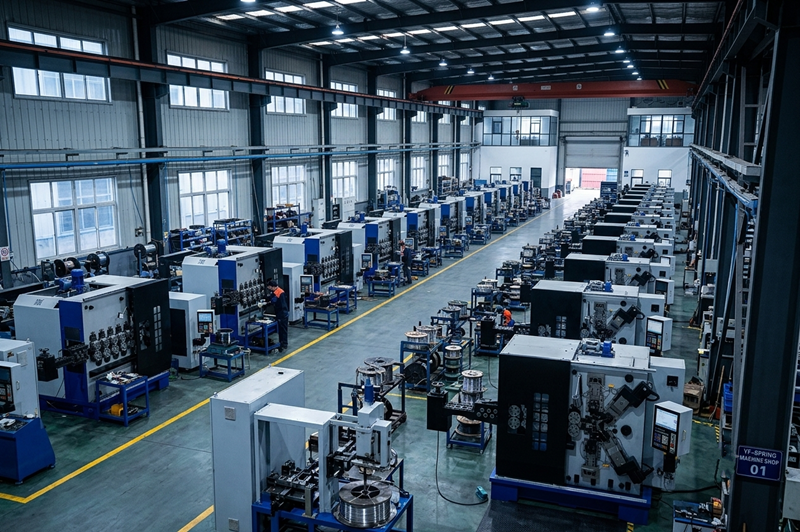
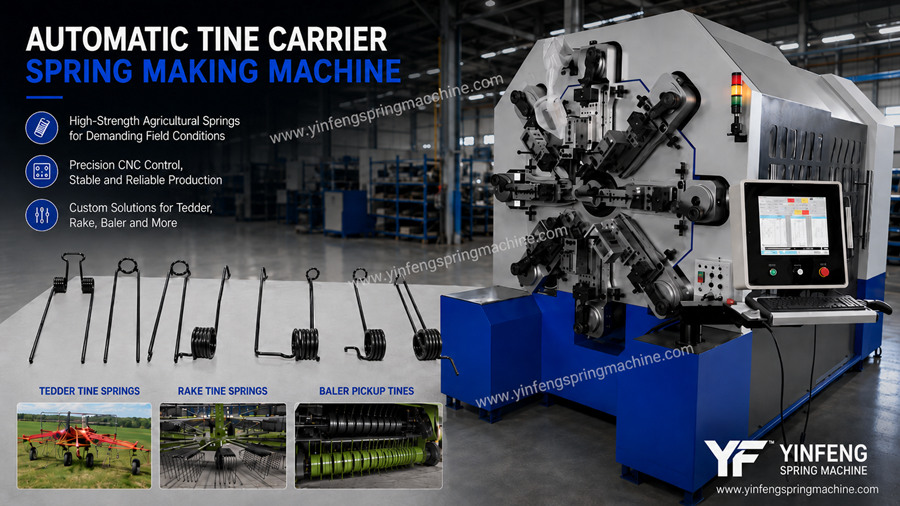
The Yinfeng Tine Carrier Spring Making Machine is an automated forming solution developed for manufacturers of agricultural spring tines and related farm machinery components.
Unlike a standard spring coiling machine that mainly produces conventional round compression springs, this equipment is designed for products combining a coiled spring section with long straight arms, angled legs, offset bends, hooks, or customized mounting ends.
The machine can coordinate wire feeding, straightening, coiling, bending, positioning, and cutting according to the required product geometry. This allows manufacturers to produce agricultural spring components with greater consistency while reducing manual bending, secondary processing, and operator dependence.
It is suitable for spring manufacturers, agricultural machinery factories, replacement-parts suppliers, and companies producing customized tine components according to drawings or physical samples.
What Is a Tine Carrier Spring?
A tine carrier spring is a functional agricultural spring component used to collect, lift, move, turn, spread, or guide crops and forage materials during field operations.
Depending on the agricultural machine and product design, the component may include:
One or more coiled spring sections
Long spring-steel arms
Straight or curved tine sections
Offset legs
Mounting bends
Hooked or shaped ends
Symmetrical or asymmetrical structures
Single-tine or double-tine configurations
These products are commonly associated with agricultural equipment such as hay tedders, rotary rakes, balers, pickup systems, forage machines, and harvesting equipment.
Because tine carrier springs operate under repeated vibration, impact, and bending loads, their geometry, material quality, forming consistency, and fatigue performance are important to the final application.
Manufacturable Products
The Tine Carrier Spring Making Machine can be configured to produce different agricultural spring components according to customer drawings and wire specifications.
Typical manufacturable products include:
Tedder Tine Springs
Rotary Rake Tine Springs
Baler Pickup Tines
Hay Rake Spring Tines
Forage Machinery Tines
Harvester Pickup Tines
Cultivator Spring Tines
Agricultural Double Torsion Springs
Tine Carrier Springs
Crop Pickup Spring Fingers
Agricultural Return Springs
Farm Machinery Retaining Springs
Custom Bent Spring Tines
Special Agricultural Wire Forms
Actual production capability depends on wire diameter, material strength, coil dimensions, arm length, bend geometry, end configuration, required tolerances, and target production speed.
Agricultural Applications
The machine is suitable for manufacturing spring components used in a wide range of agricultural equipment.
Typical applications include:
Hay Tedders
Spring tines lift and spread cut grass or hay to improve drying efficiency.
Rotary Rakes
Long spring tines gather forage into windrows while following uneven ground conditions.
Balers and Pickup Systems
Pickup tines lift hay, straw, or crop material from the field and transfer it into the baling or processing system.
Harvesting Equipment
Spring fingers and tine components guide, collect, or transport crop materials during harvesting operations.
Forage Machinery
Specially formed spring tines are used in machines that move, spread, collect, or process forage.
Cultivation and Soil Equipment
Heavy spring tines may be used for soil engagement, residue movement, weed control, or surface preparation.
Agricultural Replacement Parts
The equipment can support manufacturers producing replacement tine springs for different machinery brands and regional equipment markets.
Complete Forming Process
The production process can integrate several forming operations into one automated sequence.
1. Wire Feeding
The feeding system accurately delivers the programmed wire length into the working area.
2. Wire Straightening
The wire passes through a straightening unit to reduce coil-set curvature and prepare it for stable forming.
3. Coil Forming
The machine forms the torsion or spring coil section according to the required diameter, number of turns, and winding direction.
4. Long-Arm Forming
The wire is fed to create the required tine length or extended spring arm.
5. Multi-Angle Bending
Servo-controlled tools form mounting bends, offset sections, working angles, or special transitions.
6. End Shaping
The machine can form hooks, curved ends, mounting legs, loops, or other customized end structures where supported by the tooling configuration.
7. Cutting and Discharge
After forming is completed, the component is cut and discharged for inspection or subsequent heat treatment and surface processing.
Combining these operations in one programmed cycle helps reduce manual transfer between separate machines.
Why Agricultural Tine Springs Require Specialized Forming Equipment
Agricultural tine springs are more difficult to manufacture than standard round compression springs because they often combine coiling and long-wire forming in one component.
Important production challenges include:
Maintaining consistent coil diameter
Controlling the number and direction of coils
Producing equal or specified arm lengths
Maintaining accurate bend angles
Controlling springback after forming
Preventing long-arm deformation
Keeping left-hand and right-hand products symmetrical
Maintaining consistent mounting-end geometry
Processing high-strength spring wire
Achieving stable repeatability during batch production
A dedicated tine carrier spring machine coordinates these operations through programmable motion control, helping manufacturers improve consistency and reduce repeated manual adjustment.
Key Machine Features
Key features of the Yinfeng Tine Carrier Spring Making Machine may include:
Integrated Wire Feeding, Coiling, Bending, and Cutting
CNC-Controlled Forming Sequence
Servo-Controlled Wire Feeding
Programmable Coil and Arm Dimensions
Long-Arm Spring Forming Capability
Multi-Angle Bending Capability
Customized Tooling for Different Tine Profiles
Program Storage and Reuse
Fast Product Changeover
Adjustable Forming Parameters
Stable Batch Repeatability
Reduced Manual Forming Operations
English Control Interface
Customized Control-System Language Service
Sample Testing and Process Development Support
The final machine configuration should be selected according to the customer's product drawing, wire material, wire diameter, finished-part dimensions, and required output.
Suitable Wire Materials
The machine can be configured for common agricultural spring-wire materials, including:
High-Carbon Spring Steel Wire
Oil-Tempered Spring Wire
Alloy Spring Steel Wire
Chrome Silicon Spring Steel
Chrome Vanadium Spring Steel
Galvanized Spring Steel Wire
Stainless Spring Steel Wire
Material suitability depends on tensile strength, hardness, surface condition, wire diameter, bending radius, coil geometry, and heat-treatment requirements.
Customers should provide the material grade and mechanical-property information when requesting machine evaluation.
Recommended Yinfeng Machines for Tine Carrier Spring Production
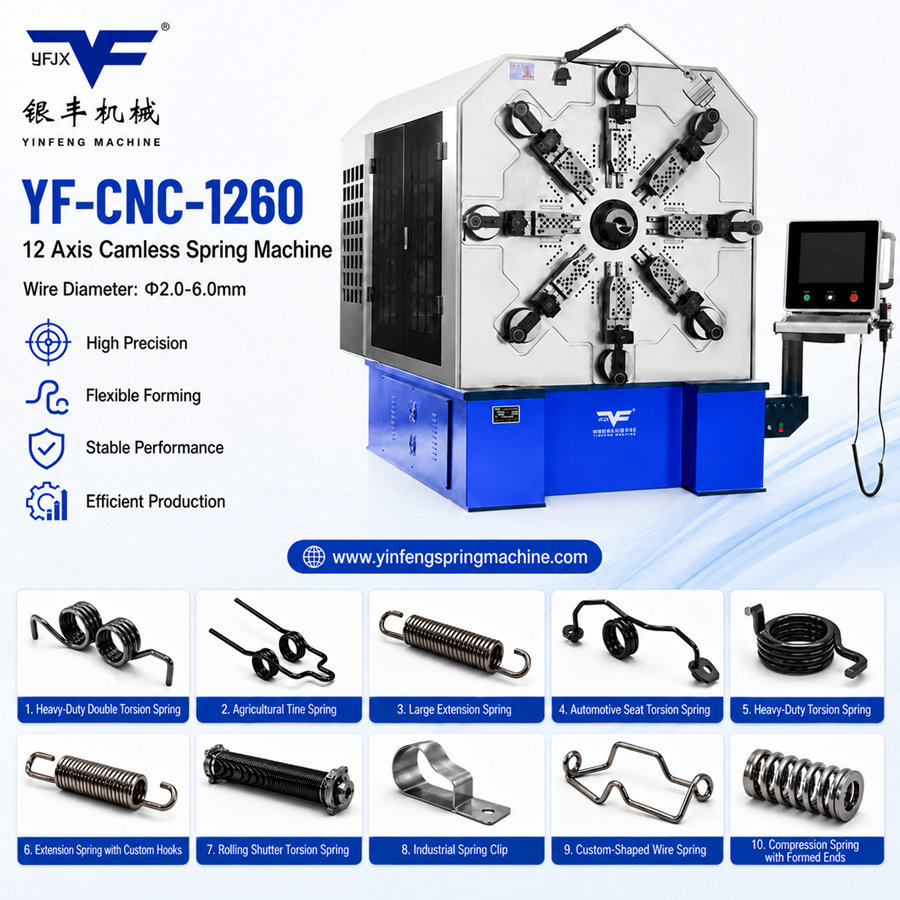
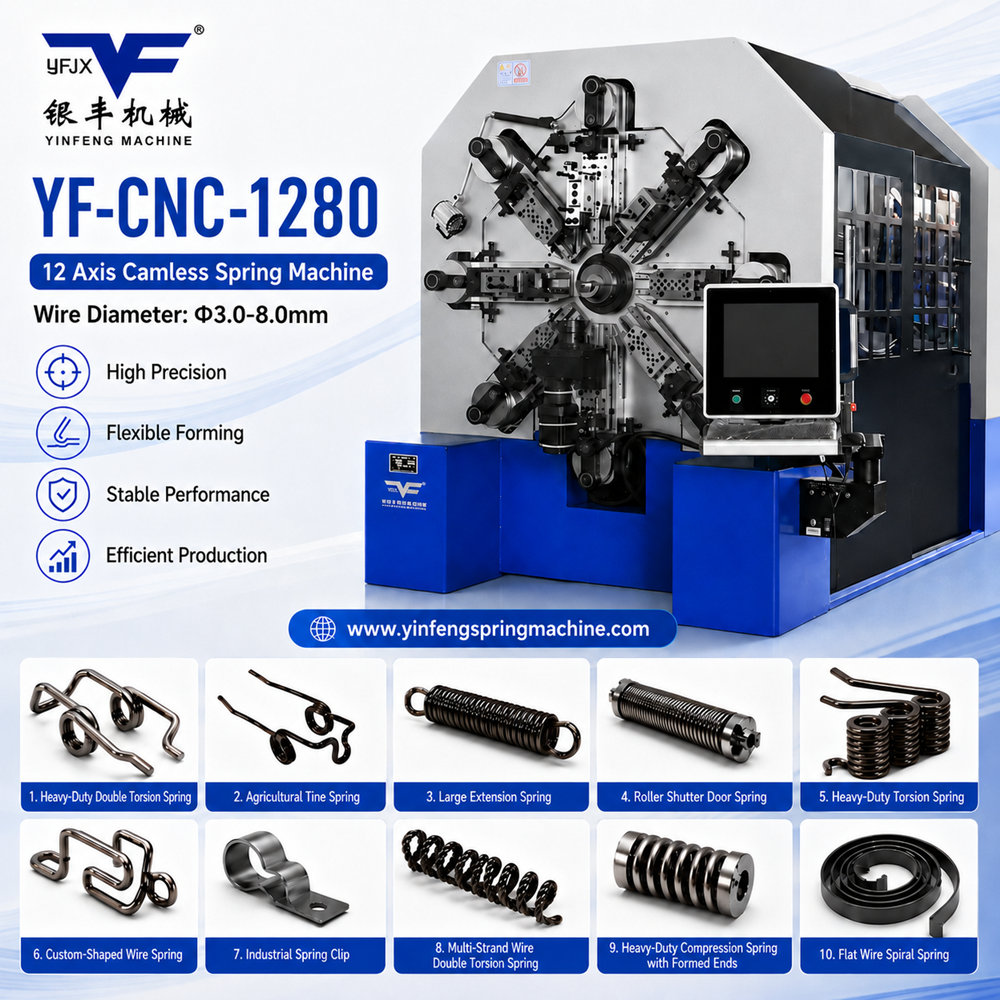
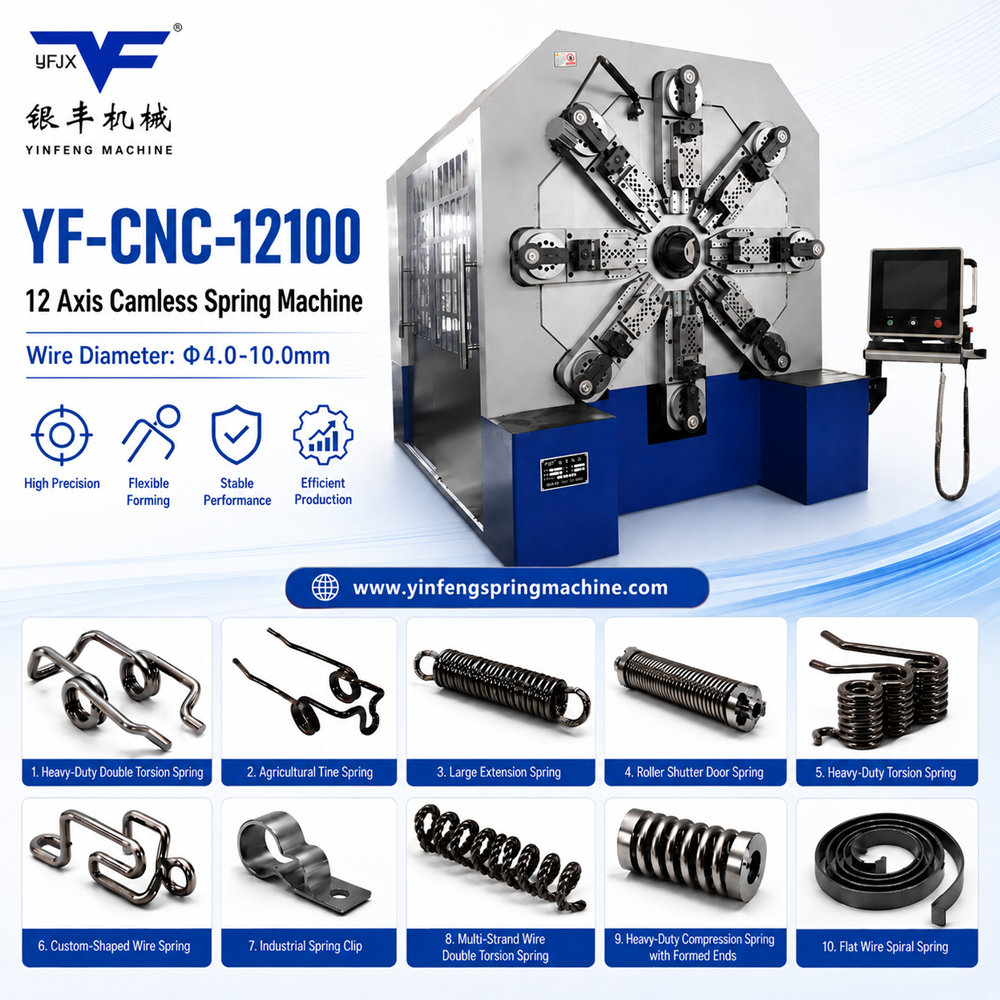
The appropriate machine depends on wire diameter, spring structure, material strength, arm length and forming complexity.
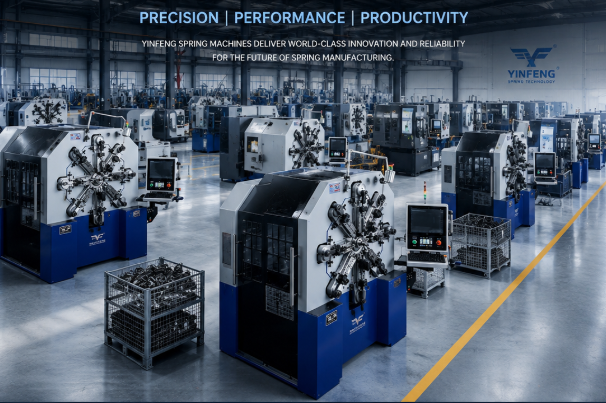
YF-CNC-1260 Camless Spring Machine
Wire Diameter: Φ2.0–6.0 mm
Recommended for medium-size agricultural torsion springs, tine springs and formed-leg spring components.
YF-CNC-1280 Camless Spring Machine
Wire Diameter: Φ3.0–8.0 mm
Recommended for large tine carrier springs, heavy torsion springs and complex agricultural spring components.
YF-CNC-12100 Camless Spring Machine
Wire Diameter: Φ4.0–10.0 mm
Recommended for heavy-duty agricultural springs requiring greater forming capacity.
Final machine selection should be confirmed according to the customer's drawing, spring material, coil dimensions, leg geometry and production requirements.
Custom Tooling and Product Evaluation
Agricultural tine springs vary significantly between machinery manufacturers, equipment models, and regional replacement-parts markets. For this reason, the forming process and tooling should be developed around the actual product rather than a generic spring category.
Yinfeng can evaluate:
Product Drawings
Physical Spring Samples
Wire Diameter
Wire Material and Tensile Strength
Coil Diameter
Number and Direction of Coils
Arm Length
Bend Angles
Mounting-End Geometry
Required Dimensional Tolerances
Target Production Speed
Left-Hand and Right-Hand Product Requirements
Based on this information, Yinfeng can recommend the appropriate machine structure, servo configuration, tooling arrangement, forming sequence, and auxiliary equipment.
Production Advantages
Integrated Manufacturing
Coiling, arm forming, bending, end shaping, and cutting can be combined within one automated production cycle.
Improved Product Consistency
Servo-controlled feeding and forming help maintain consistent wire length, coil geometry, arm position, and bend angles.
Lower Labor Requirements
Automated forming reduces dependence on manual bending and repeated operator adjustment.
Faster Repeat Orders
Optimized programs can be stored and recalled when the same tine spring is produced again.
Flexible Product Development
Forming parameters and tool movements can be adjusted to support different agricultural spring designs.
Reduced Secondary Operations
Products that previously required several machines or manual forming stages may be completed through one integrated production process.
Suitable for High-Mix Manufacturing
Different spring-tine models can be managed using separate CNC programs and corresponding tooling configurations.
Better Material Utilization
Accurate feeding and repeatable forming can help reduce trial production and material waste.
Quality Control Recommendations
To maintain stable quality during agricultural tine spring production, manufacturers should inspect:
Incoming Wire Diameter
Wire Material and Tensile Strength
Coil Inside and Outside Diameter
Number of Coils
Winding Direction
Overall Arm Length
Bend Angles
End Geometry
Left-Hand and Right-Hand Symmetry
Mounting Position
Surface Condition
Heat-Treatment Results
Spring Load or Torque Where Required
Fatigue Performance Where Required
A dedicated inspection fixture is recommended for checking long arms, mounting bends, and critical assembly positions.
The first formed sample should be inspected before continuous production begins. Periodic dimensional checks should also be performed throughout the production batch.
Recommended Production Workflow
A recommended production workflow includes:
Review the customer drawing or physical sample.
Confirm wire diameter, material grade, and tensile strength.
Determine the coil direction and forming sequence.
Design the required forming tools and wire guides.
Create the CNC production program.
Produce initial samples.
Measure coil dimensions, arm length, angles, and mounting features.
Adjust springback compensation and forming positions.
Confirm the finished sample with the customer.
Save the optimized program for repeat production.
Begin batch production with periodic quality inspections.
Complete heat treatment, surface treatment, or additional testing where required.
Why Choose Yinfeng?
Yinfeng provides customized spring and wire-forming solutions based on actual customer products rather than offering only a standard machine configuration.
Our support includes:
Product Drawing Evaluation
Physical Sample Analysis
Machine Selection Consultation
Forming-Process Development
Customized Tooling Design
Sample Production Testing
CNC Program Development Support
Factory Acceptance Testing
Installation Guidance
Operator Training
Programming Training
English Control Interface
Customized Language Service
Spare Parts Supply
Online Technical Assistance
Professional After-Sales Service
Customers can provide drawings, photographs, videos, wire information, or physical samples for production-solution evaluation.
Frequently Asked Questions
What products can the Tine Carrier Spring Making Machine produce?
It can produce tedder tine springs, rake tine springs, baler pickup tines, forage machinery tines, long-arm torsion springs, agricultural spring fingers, and customized farm-machinery spring components.
Can the machine form both coils and long arms?
Yes. The machine is designed to combine spring coiling with long-arm feeding, bending, end shaping, and cutting in one programmed production sequence.
Can it produce left-hand and right-hand tine springs?
Yes. Left-hand and right-hand products can be developed through separate programs and corresponding tooling arrangements.
Can different tine spring designs be produced on one machine?
Different products may be manufactured by changing programs, adjusting tools, or replacing dedicated forming tools. Compatibility depends on wire diameter, product size, and forming complexity.
Can the machine process high-strength spring steel?
The machine can be configured for common high-carbon and alloy spring steels. Final suitability must be evaluated according to wire diameter, tensile strength, and product geometry.
Can production programs be saved and reused?
Yes. Optimized programs can be stored and recalled for repeat orders, helping reduce setup time and maintain consistency.
Is an English control interface available?
Yes. English is available, and Yinfeng can also provide customized control-system languages according to customer requirements.
Does Yinfeng provide customized tooling?
Yes. Tooling can be designed according to the customer's spring drawing, physical sample, wire diameter, and forming requirements.
Can Yinfeng test a customer's spring before machine purchase?
Yes. Customers can submit drawings, wire specifications, photographs, videos, or physical samples for machine and process evaluation.
Is the machine suitable for replacement-parts manufacturers?
Yes. It is suitable for manufacturers producing multiple agricultural tine models and replacement components, subject to machine and tooling compatibility.
Does the spring require heat treatment after forming?
Heat treatment requirements depend on the wire material and manufacturing process. The customer should follow the material supplier's recommendations and the finished product's mechanical-performance requirements.
Conclusion
The Yinfeng Tine Carrier Spring Making Machine is a specialized automated solution for producing agricultural spring tines that combine coiled sections, long arms, multiple bends, and customized mounting ends.
By integrating wire feeding, straightening, coiling, bending, end forming, and cutting, the machine helps agricultural spring manufacturers improve product consistency, reduce manual processing, and manage multiple tine designs more efficiently.
For manufacturers producing tedder tines, rake tines, baler pickup tines, forage-machine springs, agricultural spring fingers, or customized farm-machinery components, Yinfeng can develop a machine and tooling solution based on the actual product drawing, wire specification, and production target.